
Prediction Market vs Betting: What’s the Difference


Most people encounter prediction markets for the first time and assume they already understand what they're looking at. Someone picks an outcome, puts money on it, wins or loses. Sounds familiar enough.
That's exactly why prediction markets get misunderstood as often as they do.
The surface level experience isn't that different from betting, the part where you're wrong and lose money feels pretty much the same either way. But the mechanics underneath are doing something genuinely different, and that difference isn't just semantic. It changes how prices get formed, where probabilities actually come from, and what participants are really doing when they take a position.
That distinction matters more in crypto than almost anywhere else, because prediction markets here are growing fast — showing up around World Cup outcomes, elections, Bitcoin price levels, AI product launches. The space is expanding quickly enough that it's worth being clear on what prediction markets actually are before assuming they're just betting with a different name.
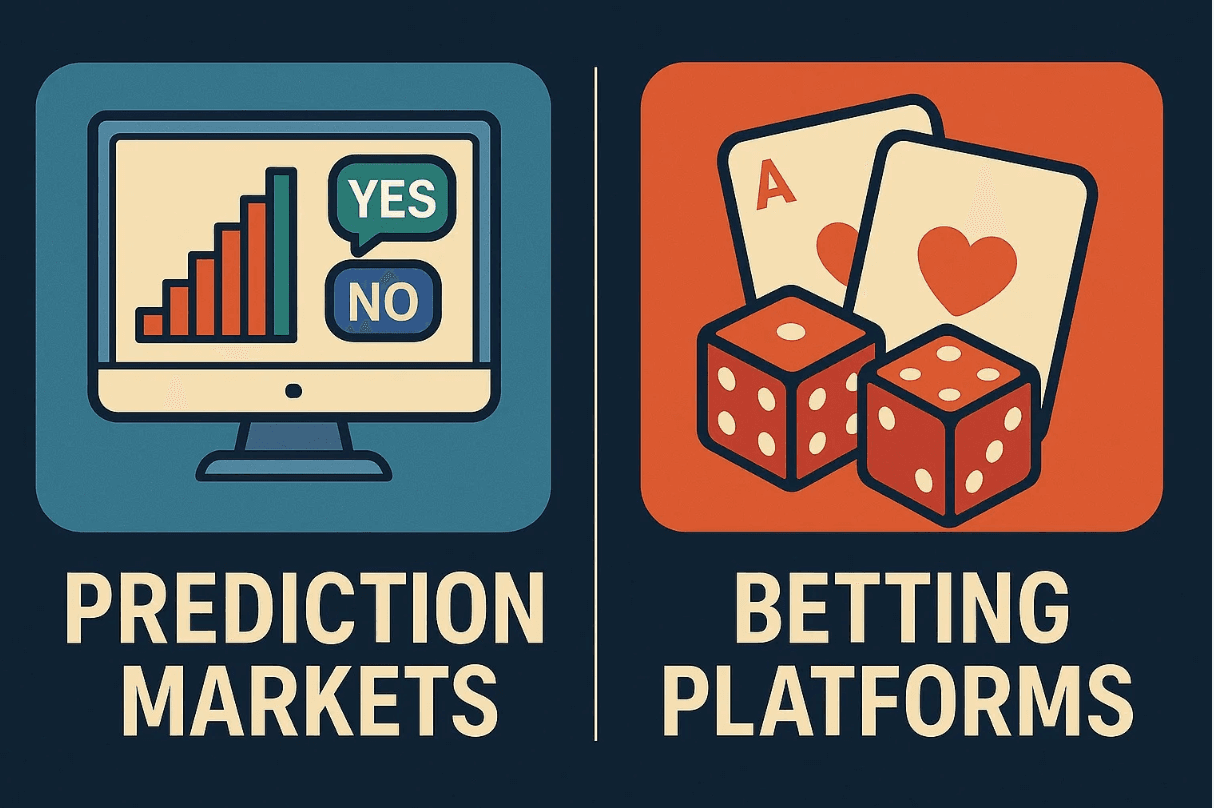
Why Prediction Markets and Betting Look Similar
The confusion is understandable. Both systems deal in uncertainty, both involve putting money behind a belief, and both ask you to make a call on something that hasn't happened yet.
A sports bettor puts money on a football match. A prediction market participant takes a position on whether a team wins the World Cup. Described that way, the two activities sound almost identical. In both cases, the underlying question is the same: what do I think is going to happen, and how sure am I?
That overlap becomes harder to ignore when prediction markets move into sports and entertainment — territory that betting has occupied for a long time. The experience of participating can feel surprisingly familiar, especially to someone who has placed a bet before.
Where things start to diverge is in how outcomes actually get priced. That's where the two systems begin doing something meaningfully different from each other.
In traditional betting, the platform sets the price and you decide whether to accept it.
A sportsbook publishes odds before anyone places a bet. Those odds determine the potential payout, and the platform controls them entirely. The bookmaker adjusts based on incoming bets, risk exposure, and — critically — its own margin. Getting the probability exactly right isn't really the goal. The goal is making sure the house comes out ahead regardless of the result.
This is what people mean when they talk about the house edge. It's not a hidden trick or fine print — it's structurally built into how the odds are presented. By the time a user sees a number, that number already reflects the platform's cut. Participants can take the odds or leave them, but they have no real influence over how those odds were formed in the first place.
The bookmaker decides. Everyone else responds.
Prediction Markets Work More Like Exchanges
Prediction markets operate differently. Instead of relying on bookmaker odds, prediction markets often function more like financial exchanges.
Prices move based on what participants collectively believe. If confidence around an outcome increases, prices generally rise. If sentiment weakens, prices fall. Rather than fixed odds, markets constantly adjust in real time. This creates something closer to a live probability estimate.
For example, if an outcome trades at 70 cents, markets may be implying roughly a 70% probability of that event happening. The important distinction is this: nobody sets the probability. The crowd does. Prices emerge through buying and selling activity.
In that sense, prediction markets resemble financial trading more than traditional betting. Participants are effectively trading opinions.
Prediction Markets Focus More on Forecasting
Another major difference comes down to purpose. Betting is often entertainment-driven. Prediction markets increasingly position themselves as forecasting tools.
This is why prediction markets keep expanding into territory that has nothing to do with sports.
Politics, economic events, AI product launches, crypto price milestones, financial market movements — the same basic mechanic applies across all of it. If there's a question with a verifiable answer, there's probably a market for it.
The idea underneath is straightforward: when people put real money behind a belief, they tend to think harder about it. A survey costs nothing to answer carelessly. A market position does. That changes the incentive, and arguably changes the quality of the signal.
That doesn't mean prediction markets are always right. They're not. But they create a different kind of input than a poll does — one where participants have a reason to actually mean what they say.
In some cases, that's proven genuinely useful. Prediction markets have shown up as meaningful reads on election sentiment and macroeconomic expectations in situations where traditional forecasting methods struggled to capture what people actually believed was going to happen.
Why Crypto Users Are Paying Attention
Prediction markets feel especially natural in crypto. That is partly because crypto users already think in probabilities.
Traders constantly evaluate future outcomes: Will Bitcoin break resistance? Will Ethereum outperform? Will a macro event move markets? Prediction markets simply package that same instinct differently. Instead of trading tokens directly, users trade probabilities tied to specific events.
Blockchain technology also makes prediction markets easier to build. Smart contracts can automate settlement, reduce intermediaries, and improve transparency. For crypto-native users who already prefer decentralized systems, this model feels familiar.
As prediction markets continue expanding, interest in future-focused narratives is also growing across crypto. Similar dynamics often appear in broader digital asset markets, where platforms such as WEEX provide access to a wide range of cryptocurrencies connected to evolving market themes and trends.
Are Prediction Markets Just Gambling?
This question appears often. The honest answer is: sometimes yes, sometimes no.
Context matters. A sports-focused prediction market may resemble betting very closely. But a market forecasting election outcomes or macroeconomic events may function more like a tool for gathering information.
Many researchers describe prediction markets as: information markets. The reasoning is that collective market activity may process information efficiently and reflect changing expectations faster than traditional methods.
Of course, risk still exists. Participants can lose money. Emotion can influence markets. And probabilities can still be wrong. Prediction markets may sometimes look smarter than traditional forecasts.
Other times, they fail completely. The distinction is not perfection. It is structure.
Which One Is Better?
The answer depends on what someone is looking for. For entertainment, traditional betting may feel simpler and more familiar. The structure is straightforward. Choose an outcome. Accept odds. Wait for results.
Prediction markets appeal to a different type of participant.Many users enjoy the dynamic pricing, shifting probabilities, and broader range of topics.
For people interested in forecasting real-world events, prediction markets may feel more intellectually engaging. Rather than simply choosing sides, participants continuously react to new information.
That makes the experience feel closer to trading than wagering.
Conclusion
Prediction markets and betting may look similar at first, but the differences become clearer once you understand how each system works.
Traditional betting relies on bookmaker-set odds and built-in profit margins. Prediction markets rely on crowdsourced pricing and changing probabilities. One is typically designed around entertainment. The other increasingly functions as a forecasting mechanism.
As crypto prediction markets continue growing, understanding these differences matters more than ever. Because the future of prediction markets may not simply be about guessing outcomes. It may be about understanding how markets collectively process information.
FAQ
1. Are prediction markets the same as betting?
Not exactly. While both involve forecasting outcomes, prediction markets rely on crowd-driven probabilities rather than bookmaker-set odds.
2. What is the biggest difference between prediction markets and betting?
Betting uses fixed odds controlled by bookmakers, while prediction markets allow prices to change dynamically based on participant sentiment.
3. Are prediction markets gambling?
Some can resemble gambling, particularly in sports. Others function more like forecasting tools for politics, economics, or crypto events.
4. Why are prediction markets popular in crypto?
Crypto users are already familiar with speculation and future-based trading, making prediction markets feel like a natural extension.
5. Can prediction markets be accurate?
Sometimes. Because users put money behind predictions, markets can reflect sentiment effectively, though outcomes are never guaranteed.
Disclaimer
This content is provided for general informational and educational purposes only and should not be considered financial, investment, legal, or tax advice. Nothing in this article constitutes an offer, recommendation, solicitation, or invitation to buy, sell, or trade any asset or use any specific service. Markets are volatile and involve risk, including the potential loss of capital. WEEX services may not be available in all regions and are subject to applicable laws, regulations, and user eligibility requirements. Please carefully assess risks before making any financial decisions.
You may also like

Norway vs England Prediction Market: Haaland vs Bellingham in the World Cup Semifinal
olymarket gives England a 53% chance of beating Norway in Saturday's World Cup quarterfinal in Miami, with a draw at 27% and Norway at 23%. The gap between the two favorites is the narrowest of any quarterfinal at this tournament. This guide examines what those numbers say about the Haaland versus Bellingham matchup and what the prediction market might be underpricing.
Argentina vs Switzerland Prediction Market: Can Messi Lead Argentina to the Final?
Polymarket gives Argentina a 57% chance of winning in 90 minutes against Switzerland, with a draw at 28% and Switzerland at 17%. Argentina escaped a two-goal deficit against Egypt in the round of 16. Switzerland have not been beaten in 90 minutes all tournament. This guide examines what those numbers reveal about Saturday's quarterfinal in Kansas City and what they leave unanswered.
What Does It Mean to Short Bitcoin? A Beginner’s Guide
Shorting is the opposite of buying. Instead of hoping Bitcoin goes up, you take a bitcoin short to…
How to Join GROVE Airdrop and Unlock 50,000 USDT Rewards
The GROVE airdrop marks Grove Finance’s token debut on WEEX with a clear, rules-based campaign that rewards deposits,…
What is Cash Cat (CASHCAT) Coin? Everything You Need to Know Before Trading CASHCAT/USDT
This article explains what Cash Cat (CASHCAT) is, how it works on Robinhood Chain, what drives demand, how…
Can CASHCAT Reach $0.15 in 2026? Cash Cat Price Prediction
KEY TAKEAWAYS CASHCAT trades around $0.09585 today based on live market dashboards such as CoinMarketCap and CoinGecko, with…
Cash Cat (CASHCAT) Price Prediction (July 2026): Forecast, Technical Levels, and Market Outlook
Cash Cat (CASHCAT) has been in the spotlight after Robinhood CEO Vlad Tenev followed the project’s account, amplifying…
SK Hynix vs Micron: Which AI Memory Stock Offers Better Value in 2026?
SK Hynix vs Micron: Which AI memory stock is the better buy in 2026? Compare HBM leadership, valuation, and risks. Trade SKHYNIX and MU on WEEX with perpetual futures.
Spain vs Belgium Prediction Market: What Polymarket Odds Say About the World Cup Quarterfinal
Polymarket gives Spain a 60% chance of beating Belgium in Friday's World Cup quarterfinal in Los Angeles. Belgium sits at 17% and a draw at 25%. Spain has not conceded a single goal in five matches. Belgium barely survived their group stage. This guide explains what the prediction market odds actually mean and what they are telling you about Friday's match.
Apple Stock Is About to Overtake Nvidia as the World's Most Valuable Company
Apple stock and Nvidia are separated by roughly $200 billion in market capitalization, the smallest gap between the two since Nvidia first overtook Apple to claim the top spot. Apple stock has gained significantly in recent sessions while Nvidia has faced pressure. This guide examines what closing that gap would mean, what is driving it, and whether Apple stock reclaiming the top position changes anything fundamental for investors.
Apple Stock Price Prediction 2026–2027: Can AAPL Reach $400?
Apple stock is trading around $312, close to its all time high of $317. Getting to $400 by end of 2027 means roughly 28% appreciation from current levels. This guide examines what the path to $400 actually requires and what the realistic range of outcomes looks like over the next eighteen months.
Apple Stock and the $30 Billion Broadcom Chip Deal: What It Means for AAPL Investors
Apple stock rose after announcing an expanded chip supply partnership with Broadcom extending through 2031. The deal covers custom ASIC chips and represents one of the largest supply commitments Apple has made with a single partner. This guide examines what the Broadcom deal actually means for Apple stock and why the market reacted the way it did.
Amazon Stock and the Anthropic IPO: Why It Could Change Everything for AMZN
Anthropic is expected to go public before end of 2026 at a valuation that could make Amazon's stake worth hundreds of billions. Amazon stock has already gained roughly 91% this year. The Anthropic IPO adds a separate catalyst on top of the core AWS and advertising story. This guide examines what that catalyst actually means and why it matters more than most Amazon coverage acknowledges.
SK Hynix Nasdaq Listing 2026: What Investors Need to Know About SKHY Stock
SK Hynix stock analysis 2026: Is SKHY a good investment after the Nasdaq debut? Learn how to trade SKHYNIX/USDT on WEEX.
Is Amazon Stock a Buy After a 91% Rally and a $25 Billion Bond Sale?
Amazon stock has gained roughly 91% over the past year and is trading around $245. The company just announced a $25 billion bond sale to fund AI infrastructure, its largest debt offering in recent history. This guide focuses on the buy-or-wait decision at current levels rather than repeating what the business does.
Amazon Stock Price Prediction 2026–2030: Can AMZN Reach $500?
Amazon stock is trading around $245, up roughly 91% over the past year. Getting to $500 by 2030 requires approximately doubling from current levels over four years. This guide examines what that path requires across the three independent business drivers that will determine where Amazon stock trades by the end of the decade.
SK Hynix Stock Forecast 2026: Is SKHYNIX a Good Investment in July 2026?
SK Hynix stock analysis 2026: HBM demand, earnings growth, and risks explained. Should you invest in SKHYNIX? Read our full forecast and trading guide.
CDOF Crypto Review 2026: Is the Chinese Digital Oil Fund Token a Good Investment in July?
What is CDOF crypto? Learn about the Chinese Digital Oil Fund token on Solana, its market performance, potential risks, and whether it's worth buying in July 2026.
Norway vs England Prediction Market: Haaland vs Bellingham in the World Cup Semifinal
olymarket gives England a 53% chance of beating Norway in Saturday's World Cup quarterfinal in Miami, with a draw at 27% and Norway at 23%. The gap between the two favorites is the narrowest of any quarterfinal at this tournament. This guide examines what those numbers say about the Haaland versus Bellingham matchup and what the prediction market might be underpricing.
Argentina vs Switzerland Prediction Market: Can Messi Lead Argentina to the Final?
Polymarket gives Argentina a 57% chance of winning in 90 minutes against Switzerland, with a draw at 28% and Switzerland at 17%. Argentina escaped a two-goal deficit against Egypt in the round of 16. Switzerland have not been beaten in 90 minutes all tournament. This guide examines what those numbers reveal about Saturday's quarterfinal in Kansas City and what they leave unanswered.
What Does It Mean to Short Bitcoin? A Beginner’s Guide
Shorting is the opposite of buying. Instead of hoping Bitcoin goes up, you take a bitcoin short to…
How to Join GROVE Airdrop and Unlock 50,000 USDT Rewards
The GROVE airdrop marks Grove Finance’s token debut on WEEX with a clear, rules-based campaign that rewards deposits,…
What is Cash Cat (CASHCAT) Coin? Everything You Need to Know Before Trading CASHCAT/USDT
This article explains what Cash Cat (CASHCAT) is, how it works on Robinhood Chain, what drives demand, how…
Can CASHCAT Reach $0.15 in 2026? Cash Cat Price Prediction
KEY TAKEAWAYS CASHCAT trades around $0.09585 today based on live market dashboards such as CoinMarketCap and CoinGecko, with…