
WXT Burn for Q1 2026: WEEX Completes 62,998,141 WXT Token Burn


KEY TAKEAWAYS
WEEX has completed its Q1 2026 WXT token burn, removing 62,998,141 WXT from circulation as part of the WXT Burn Model. Users who want to follow WXT ecosystem updates can register on WEEX and track future platform announcements.
The burn value was approximately $1,004,127, calculated based on the market price on the date of the burn.
The transaction has been recorded on-chain, supporting WEEX's commitment to transparency and verifiable token supply management.
After this burn, the total amount of WXT burned has reached 4,253,096,699 WXT, while the current supply stands at 5,746,903,301 WXT.
The Q1 2026 burn reflects WEEX's ongoing effort to support the long-term development of the WXT deflationary ecosystem.
WEEX Completes Q1 2026 WXT Token Burn
WEEX has officially completed its Q1 2026 WXT token burn, marking another step in the platform's long-term deflation strategy for WEEX Token (WXT). The latest burn removed 62,998,141 WXT from circulation, with an estimated burn value of $1,004,127 based on the market price on the date of the burn.
Token burns are an important part of WXT's ecosystem design. By permanently removing a portion of tokens from the circulating supply, WEEX aims to support a more sustainable token economy and strengthen WXT's long-term value framework. This Q1 2026 burn was carried out in line with the official WXT Burn Model.
The announcement was released by WEEX on 2026/06/18 at 11:00:00. Users can verify the burn through the official on-chain burn record.
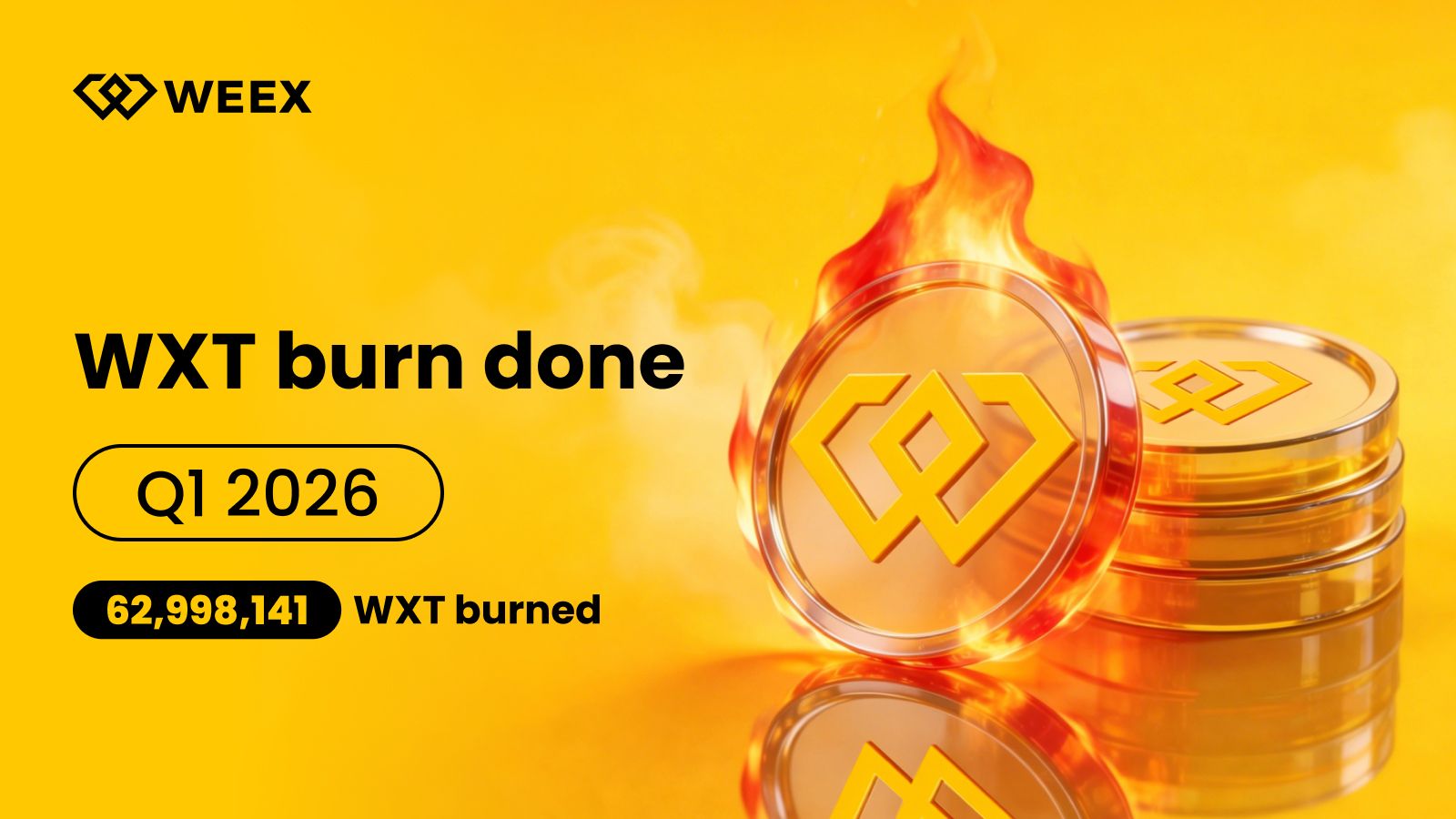
Q1 2026 WXT Burn Details
For this burn cycle, WEEX removed a total of 62,998,141 WXT from circulation. The burn value was approximately $1,004,127, calculated using the market price on the burn date. These figures help users understand both the size of the burn and its market-value equivalent at the time it was completed.
The key burn details are: quantity burned, 62,998,141 WXT; burn value, $1,004,127; total WXT burned after this cycle, 4,253,096,699 WXT; and current WXT supply after this cycle, 5,746,903,301 WXT. Together, these numbers show the continued execution of the WXT deflationary model.
Instead of treating token burns as one-time events, WEEX uses a structured model to guide burn activity and maintain a transparent supply reduction process. For WXT holders and WEEX users, this makes it easier to follow how the token economy evolves over time.
How the WXT Burn Model Works
The WXT Burn Model is designed to connect burn activity with multiple platform and market-related factors. According to the model, the burn calculation considers trading volume, price volatility, platform scale, liquidity conditions, and a base constant.
[Insert burn model formula image here: 销毁模型公式.webp]
The model includes the following parameters: Period (T), Trading Volume (V), Price Volatility Factor (sigma) of 0.513, Platform Scale Effect Term of ln(V)^0.2, Market Liquidity Adjustment Parameter (lambda) of 17.524, and Base Constant (C) of 10,000,000 WXT.
This structure helps make the burn process more systematic. Rather than using a simple fixed amount, the model reflects platform activity and market conditions during the burn period. For users following WXT, this provides a clearer framework for understanding how token supply reduction may be carried out over time.
Why WXT Burns Matter
A token burn permanently removes tokens from circulation. In the case of WXT, burns are used to support a deflationary ecosystem and reduce the available token supply over time. While token burns do not guarantee price appreciation, they can play an important role in token economy design when combined with real platform growth, user demand, and continued ecosystem utility.
For WEEX, WXT is connected to the broader platform ecosystem. As WEEX continues building products, services, and user benefits around WXT, transparent supply management becomes an important part of maintaining long-term market confidence. Users who want to monitor market activity can also follow the WXT/USDT spot market.
Post-Burn WXT Supply Overview
After the Q1 2026 burn, the cumulative amount of WXT burned has reached 4,253,096,699 WXT. The current WXT supply now stands at 5,746,903,301 WXT. This updated supply structure reflects the continued execution of WEEX's deflationary plan.
Each completed burn adds to the total amount permanently removed from circulation, helping users track the long-term progress of the WXT burn mechanism. WEEX remains committed to openness and transparency by publishing burn quantities, burn value, model parameters, and on-chain records.
What This Means for WEEX Users
For WEEX users, the Q1 2026 WXT burn is a signal of continued ecosystem development. It shows that WEEX is actively executing its token supply strategy and maintaining regular communication around WXT's deflationary mechanism.
Users should also understand token burns in a balanced way. A burn can reduce supply, but market value still depends on broader factors such as platform growth, trading demand, liquidity, user adoption, and overall crypto market conditions. WXT burns should be viewed as one part of the token's long-term ecosystem, not as a guaranteed price driver.
New users can also explore the WEEX welcome bonus to learn more about available platform incentives.
Conclusion
WEEX has completed its Q1 2026 WXT token burn, permanently removing 62,998,141 WXT from circulation with an estimated burn value of $1,004,127. After this burn, the total amount of WXT burned has reached 4,253,096,699 WXT, while the current supply stands at 5,746,903,301 WXT.
This burn reflects WEEX's continued commitment to building a transparent, deflationary WXT ecosystem. As the platform grows, WEEX will continue advancing its token strategy, strengthening supply transparency, and supporting WXT's long-term ecosystem development.
FAQ
1. What is the Q1 2026 WXT burn?
The Q1 2026 WXT burn is a token supply reduction event completed by WEEX, removing 62,998,141 WXT from circulation.
2. What was the value of the Q1 2026 WXT burn?
The burn value was approximately $1,004,127, based on the market price on the burn date.
3. Where can users verify the WXT burn?
Users can verify the burn through the on-chain transaction record published by WEEX.
4. How much WXT has been burned in total?
After the Q1 2026 burn, the total amount of WXT burned has reached 4,253,096,699 WXT.
5. What is the current WXT supply after the burn?
The current WXT supply after this burn is 5,746,903,301 WXT.
6. Does a WXT burn guarantee price growth?
No. Token burns can reduce supply, but price performance still depends on demand, liquidity, market sentiment, platform growth, and broader crypto conditions.
7. Why does WEEX burn WXT?
WEEX burns WXT to support the token's deflationary ecosystem, improve supply transparency, and strengthen the long-term token economy.
DISCLAIMER: WEEX and affiliates provide digital asset exchange services, including derivatives and margin trading, onlywhere legal and for eligible users. All content is general information, not financial advice-seek independentadvice before trading. Cryptocurrency trading is high risk and may result in total loss. By using WEEX services you accept all related risks and terms. Never invest more than you can afford to lose. See our Terms of Use and Risk Disclosure for details.
You may also like

How to Install and Set Up Phantom Wallet?
This step-by-step guide shows how to install Phantom Wallet on desktop and mobile, create or import a wallet,…
What Is Phantom Wallet? A Complete Guide to the Solana Wallet
Phantom Wallet is a free, non-custodial wallet built for Solana and now also compatible with Ethereum and Polygon.…
How to Connect Ledger to MetaMask
Connecting a Ledger hardware wallet to MetaMask gives you hardware-level key security with the familiar MetaMask interface for…
How to Set Up and Initialize Your Ledger Wallet
Setting up a Ledger hardware wallet is the most reliable way for beginners to control crypto keys without…
Is Ledger Safe? How Private Key Storage Works
Is Ledger safe for storing your crypto? This guide explains how Ledger’s secure element chip stores private keys,…
Ledger Nano S vs. Nano X vs. Stax: Which One Should You Choose
This guide breaks down the Ledger lineup—Nano S, Nano X, and Stax—so you can choose a hardware wallet…
What Is a Ledger Hardware Wallet? A Beginner’s Guide
A Ledger hardware wallet stores your private keys offline on a small device and signs transactions without exposing…
$TCCBSC Airdrop on WEEX: Complete Guide to TCryptochicks and Claim Free $TCCBSC
Learn TCryptochicks token details, BNB Chain market data, and how eligible users can claim rewards from the WEEX 50,000 USDT TCCBSC airdrop before July 13, 2026 at 09:00 UTC.
$ARX Airdrop on WEEX: Complete Guide to Arcium and Claim Free $ARX
Arcium tokenomics connect confidential-compute staking and governance with ARX utility, while eligible users can join the WEEX ARX campaign to claim rewards from a 50,000 USDT prize pool before July 10, 2026 at 17:00 SGT.
What is TCryptochicks(TCCBSC) Coin — everything you need to know, how to buy, and what should you do
This guide explains what TCryptochicks (ticker TCCBSC) is, how it works on BNB Chain, how to buy it,…
Is SIVE Stock a Good Investment in 2026? AI Photonics Opportunity
Sivers Semiconductors (SIVE) sits at the nexus of AI photonics, where lasers, silicon photonics, and 1.6T optical links…
What is The Final Form Bull(CZ) Coin: a comprehensive guide you don’t want to miss
This guide explains what The Final Form Bull (CZ) coin is, how it works on BNB Smart Chain,…
What is The Black Table(MENSA) Coin? Everything you need to know, how to buy, and don’t miss that MENSA/USDT listing
The Black Table (ticker: MENSA) is a Solana-based community token themed around a smiley “table,” designed to project…
How to Install and Set Up MetaMask (2026 Updated Guide)
Version note: Current stable build (verified July 6, 2026). Check Settings > About for your exact version, as…
MetaMask vs. Trust Wallet: Which Should You Use?
Choosing between MetaMask and Trust Wallet comes down to the chains you use, how you manage keys, and…
MetaMask Seed Phrase & Private Key Security Guide
MetaMask is a non-custodial wallet, which means you alone control the keys to your crypto. This guide explains…
MetaMask Transaction Stuck or Failed? Here’s How to Fix It
MetaMask is the go-to wallet for DeFi, NFTs, and on-chain swaps, but transactions can stall or fail when…
What Is MetaMask? A Complete Beginner’s Guide
MetaMask is a free self-custody crypto wallet that lives in your browser or phone. Think of it as…
How to Install and Set Up Phantom Wallet?
This step-by-step guide shows how to install Phantom Wallet on desktop and mobile, create or import a wallet,…
What Is Phantom Wallet? A Complete Guide to the Solana Wallet
Phantom Wallet is a free, non-custodial wallet built for Solana and now also compatible with Ethereum and Polygon.…
How to Connect Ledger to MetaMask
Connecting a Ledger hardware wallet to MetaMask gives you hardware-level key security with the familiar MetaMask interface for…
How to Set Up and Initialize Your Ledger Wallet
Setting up a Ledger hardware wallet is the most reliable way for beginners to control crypto keys without…
Is Ledger Safe? How Private Key Storage Works
Is Ledger safe for storing your crypto? This guide explains how Ledger’s secure element chip stores private keys,…
Ledger Nano S vs. Nano X vs. Stax: Which One Should You Choose
This guide breaks down the Ledger lineup—Nano S, Nano X, and Stax—so you can choose a hardware wallet…