
What is the Funding Rate? A Comprehensive Guide to Mechanisms, Calculations, and Market Application

 Prefer us on Google


When you start futures trading, you will encounter the terms "Funding Rate." This is a mechanism where payments or receipts occur periodically just by holding a position, and it becomes a cost or revenue factor that cannot be ignored for long-term holdings.
This article explains the mechanism of the funding rate, the meaning of positive and negative values, its impact on trading costs, and how to use it as an indicator to read market overheating.
What is the Funding Rate?
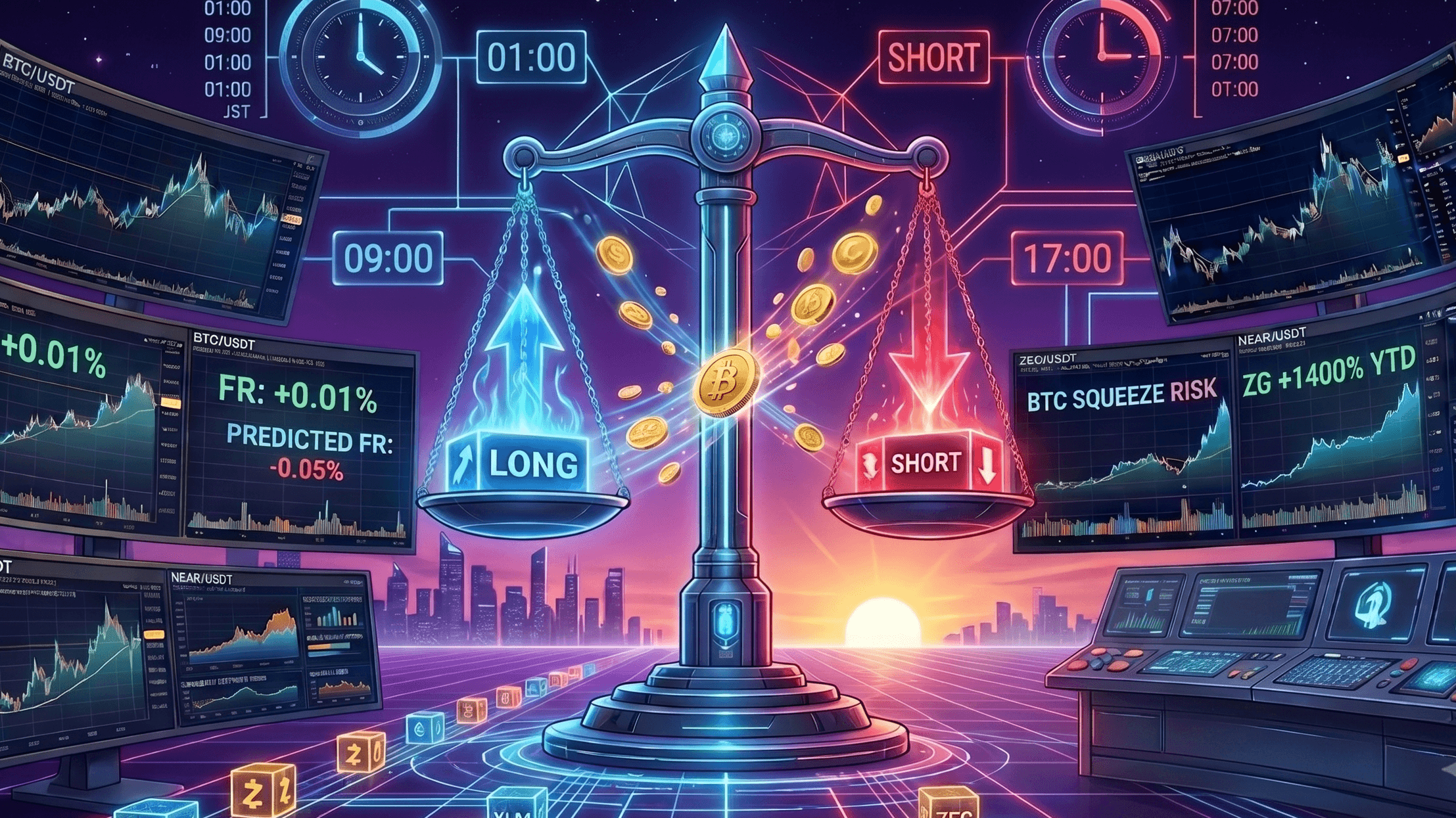
The funding rate is a periodic payment and receipt mechanism designed in perpetual futures to keep the futures price close to the spot price.
Regular futures have an expiration date, and the price converges to the spot price at maturity. However, since perpetual futures have no expiration date, there is a risk that the futures price and spot price will continue to diverge. To correct this divergence, a periodic adjustment cost called the "funding rate" is established.
| Status | Funding Rate Direction | Who Pays Whom |
| Futures Price > Spot Price (Bullish) | Positive | Long holders pay short holders |
| Futures Price < Spot Price (Bearish) | Negative | Short holders pay long holders |
| Futures Price ≈ Spot Price | Near zero | Almost no payment |
Concrete Calculation Example
BTC position of 10,000 USDT, with a funding rate of 0.01% (every 8 hours).
Payment per instance: 10,000 USDT × 0.01% = 1 USDT
Daily payment: 1 USDT × 3 times (every 8 hours) = 3 USDT
Monthly payment: 3 USDT × 30 days = approximately 90 USDT
Even with a small number like 0.01%, costs accumulate as the position size increases and the holding period lengthens. Holding large positions for a long time when the funding rate is high is disadvantageous in terms of costs.
How to Interpret the Funding Rate
When it remains positive (Bull Market)
When the funding rate remains positive, it means that there are many long positions and the futures price continues to be higher than the spot price. It indicates a state where the majority of market participants believe prices will rise.
However, if the positive rate becomes extremely high (e.g., 0.1% or more), it is a sign of "market overheating." If long positions accumulate too much, a "long squeeze," where a large number of liquidations occur in a chain reaction, becomes more likely with even a slight decline.
When it remains negative (Bear Market)
When the funding rate is negative, there are many short positions and the futures price is lower than the spot price. This is a state where many participants believe prices will fall, and it is a signal that traders looking for contrarian long entries pay attention to.
If the negative rate is extremely large, the risk of a "short squeeze" increases. Sudden surges like those seen in ZEC or NEAR in 2026 are often triggered by short squeezes.
When it is near zero (Neutral)
The futures and spot prices are almost identical, and the balance between long and short is maintained. This is often seen in "range markets" where the trend is unclear.
How to Check on WEEX
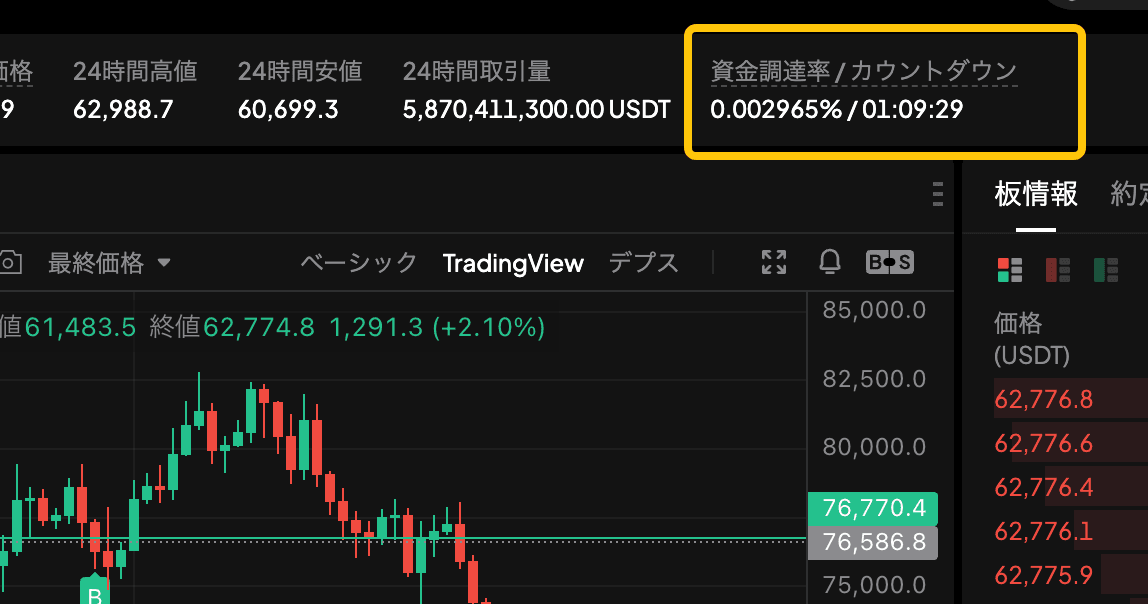
On the WEEX futures trading screen, the "Funding Rate" and "Time remaining until next settlement (countdown)" are displayed in the trading pair details. Settlement occurs every 8 hours, and if you hold a position at the settlement time, payments or receipts occur automatically.
Settlement times (JST): 3 times a day at 08:00, 16:00, and 24:00. Whether you hold a position at these times determines whether a funding fee is incurred. Setting an alarm might make it easier to manage.
Time remaining until next settlement: Displayed as a "countdown" on the screen. By checking the current rate just before settlement, you can grasp the cost incurred in the current settlement in advance.
Information available: Current funding fee (%), time remaining until next settlement, and past funding fee history. Settlement records can be checked from "Assets" > "Transaction" > "Futures Trading" (listed as "Funding Fee").
There is also a method to avoid funding rate costs by closing a position just before the settlement time and re-entering immediately after, but it is necessary to consider the balance with trading fees.
Application to Trading Strategies
Cost Management: When holding long-term positions, it is important to calculate the cumulative cost of the funding rate in advance. The higher the leverage, the larger the position size and the higher the cost.
Grasping Market Sentiment: The funding rate can be used as a "market sentiment indicator" that reflects the supply and demand balance between long and short. An extremely positive rate suggests overheating, while an extremely negative rate suggests the possibility of a bottom.
Funding Rate Arbitrage: By holding a long position in spot while opening a short position in futures, you can hedge price fluctuation risks while receiving the positive portion of the funding rate (delta-neutral strategy). However, sufficient knowledge and margin management are required for execution.
Summary
The funding rate is a periodic payment and receipt mechanism in perpetual futures to bring the futures price closer to the spot price. When positive, it indicates many longs and a bullish sentiment; when negative, it indicates many shorts and a bearish sentiment. Extreme values are signs of market overheating or reversal.
If you are holding long-term positions, be sure to check the cumulative costs, and we recommend checking the current rate and next settlement time on the WEEX futures screen before trading.
FAQ
Q. When are funding fees deducted?
At WEEX, settlement is performed 3 times a day (every 8 hours) at 08:00, 16:00, and 24:00 JST. If you hold a position at these times, payment or receipt occurs automatically. Settlement records can be checked from "Assets" > "Transaction" > "Futures Trading." If you close your position before the settlement time, the funding fee for that instance will not be incurred.
Q. What happens if the funding rate is high?
If the funding rate is high and positive, long holders will continuously pay short holders. Since costs accumulate for long-term holdings, consider reducing your position size or shortening your holding period when a high funding rate persists. Also, if it is extremely high, it indicates market overheating, so be aware of reversal risks.
Q. Where are funding fees paid?
They are paid directly from long holders to short holders (or vice versa) without going through the exchange. WEEX does not take fees from funding fees. If the funding rate is positive, short holders receive it; if negative, long holders receive it.

Disclaimer
WEEX and its affiliates provide digital asset exchange services, including derivatives and margin trading, only to eligible users in legally permitted regions. This content is for general information purposes only and is not investment advice. Always consult with a professional before trading. Cryptocurrency trading carries high risk, and you may lose all of your invested funds. By using WEEX services, you are deemed to have agreed to all relevant risks, Terms of Service, and Risk Disclosure. Please make your own decisions and invest within your means.
Disclaimer: This content is provided for general branding and informational purposes only and doesn't constitute financial, investment, legal, or tax advice. Any events, rewards, online events, or related information mentioned herein should not be considered a recommendation, solicitation, or invitation to purchase, sell, trade, or otherwise deal in any crypto assets or to use any services. Crypto assets are highly volatile and may result in loss. WEEX services and online events may not be available in all regions and are subject to applicable laws, regulations, and eligibility requirements. You are responsible for ensuring that your use of WEEX services complies with local laws and for carefully assessing the risks before participating in any crypto-related activities.
You may also like
USA Rare Earth Stock (USAR): Bull Case, Risks, and the 2028 Bet
USA Rare Earth stock (USAR) explained — what the company does, why shares slumped in 2026, the Round Top bull case, the MP Materials lawsuit, and key risks.
USAR Stock Price Prediction: Can USA Rare Earth Reclaim $40?
USAR stock price prediction: USA Rare Earth trades near $19 vs a $36–$39 analyst target. Bull case, bear case, and 2026–2030 scenarios.

Meta Stock in 2026: Price, Forecast, and How to Trade It
Meta stock near $630 in July 2026, down YTD on AI capex fears. See the price, analyst forecast, bull vs bear case, and how to trade META exposure.

Costco Stock (COST): Price, Forecast, and Is It a Buy in 2026
Costco stock (COST) trades near $915–950 in July 2026 at ~48x earnings. See the latest price, analyst forecast, dividend, and how to buy.
SK Hynix Stock: Inside the AI Memory Giant's Nasdaq Debut
SK Hynix stock lists on Nasdaq July 10 as SKHY in the biggest ADR debut ever. Price, 2026 forecast, HBM bull/bear case, and how to buy.
Risks of Shorting Bitcoin You Should Know Before You Trade
Shorting can look simple: you profit when price falls. But the bitcoin short is different from buying because…

Shorting Bitcoin vs Buying Put Options: What’s the Difference
This guide breaks down two ways to express a bearish view on BTC: opening a bitcoin short with…
Prismevm (PP) Airdrop on WEEX: How to Unlock New User Rewards
This guide explains what Prismevm (PP) is, how the Prismevm (PP) airdrop on WEEX works, and a simple,…
How to Short Bitcoin: Methods and Platforms Compared
A bitcoin short lets you profit if BTC falls. This guide explains how to short bitcoin using futures,…
What Is Dollar-Cost Averaging (DCA)? A Beginner’s Guide
Dollar-cost averaging (DCA) is a simple strategy: invest a fixed amount on a fixed schedule, no matter the…
What Does It Mean to Short Bitcoin? A Beginner’s Guide
Shorting is the opposite of buying. Instead of hoping Bitcoin goes up, you take a bitcoin short to…
How to Join GROVE Airdrop and Unlock 50,000 USDT Rewards
The GROVE airdrop marks Grove Finance’s token debut on WEEX with a clear, rules-based campaign that rewards deposits,…
What is Cash Cat (CASHCAT) Coin? Everything You Need to Know Before Trading CASHCAT/USDT
This article explains what Cash Cat (CASHCAT) is, how it works on Robinhood Chain, what drives demand, how…
Bitcoin Price Prediction 2026: Is the BTC Bottom Finally In?
This article maps a clear path to Bitcoin Price Prediction 2026 and weighs the question: Is the BTC…
Aptos (APT) Token Unlock July 12: Will APT Price Crash?
Aptos (APT) faces a scheduled token unlock on July 12, and traders are asking if the added supply…
What is Bitmine BMNR and Why Does It Own 5.7 Million ETH?
This article explains the claim that “Bitmine BMNR” controls 5.7 million ETH, what Bitmine BMNR might be, how…
Why is XRP Price Pumping Today After Ripple MiCA License Approval?
XRP price momentum accelerated after reports that Ripple secured a MiCA-compliant authorization in the EU, a milestone that…
Why Did Bitcoin Drop 33% While Semiconductor Stocks Pumped 102%?
Bitcoin’s 33% drawdown alongside a 102% surge in semiconductor stocks looks contradictory, but the gap is explainable. This…

Is Bitmine Immersion Technologies Safe? BMNR Crypto Holdings Explained
This guide breaks down what Bitmine BMNR and BMNR Crypto could represent, how to judge safety for Bitmine…
Why is Bitcoin Crashing Below 64K After the Weekend Rally?
Bitcoin’s slide below 64K after a strong weekend bounce looks jarring, but the mechanics are familiar: thin weekend…
Crypto Kidnapping and Torture Case: 5 Crucial Rules to Protect Your Cold Wallet Private Keys
Crypto kidnapping is a blunt, offline attack that targets you—not your code. This guide explains how kidnappers force…
What is Trump Crypto Coin and Why Did It Lose 3.8 Billion Dollars?
This article explains what people mean by “Trump Crypto” coin, why multiple Trump-themed tokens surged and then rapidly…
What is Ripple MiCA Crypto Authorization and How Does It Work?
Ripple MiCA Crypto Authorization refers to the process a Ripple-affiliated entity would follow to operate legally under the…
Is Trump Crypto Coin a Scam? The $3.8 Billion Loss Report Explained
“Trump Crypto” has become a catch-all label for tokens, NFTs, and memecoins that reference the former U.S. president.…

What is the Patrick Witt Crypto Bill? US Strategic Bitcoin Reserve Explained
This article explains what people mean by the “Patrick Witt Crypto Bill,” why a U.S. Strategic Bitcoin Reserve…

What Is CASHCAT Crypto and Why Did It Pump 950% Today?
What is CASHCAT crypto? Robinhood Chain memecoin surged 950% on July 8 after CEO's tweet. One trader turned $838 into $1M. Full analysis, risks, and what to know. (156 characters)
Alibaba Stock in 2026: Price, Forecast, and How to Trade BABA
Alibaba stock trades near $109 in mid-2026 with analyst targets around $190. Here's the BABA outlook, the real risks, and how to trade it with USDT.
NVIDIA Stock in 2026: Price, Forecast, and How to Trade It
NVIDIA stock hit ~$204 in July 2026 with a forward P/E near a 6-year low. See what's driving NVDA, the bull vs bear case, and how to trade it on WEEX.
SNDK Stock: Why SanDisk Soared and How to Trade It
SNDK stock is up ~892% in 2026 on the AI-storage boom. See the price today, analyst forecasts, split odds, and how to trade SNDK on WEEX.
SNDK Stock: SanDisk's AI Memory Surge and 2026 Outlook
SNDK stock is up ~635% in 2026 on the AI memory boom. See SanDisk's price, earnings, analyst forecast, risks, and how to get exposure.
USA Rare Earth Stock (USAR): Bull Case, Risks, and the 2028 Bet
USA Rare Earth stock (USAR) explained — what the company does, why shares slumped in 2026, the Round Top bull case, the MP Materials lawsuit, and key risks.
USAR Stock Price Prediction: Can USA Rare Earth Reclaim $40?
USAR stock price prediction: USA Rare Earth trades near $19 vs a $36–$39 analyst target. Bull case, bear case, and 2026–2030 scenarios.
Meta Stock in 2026: Price, Forecast, and How to Trade It
Meta stock near $630 in July 2026, down YTD on AI capex fears. See the price, analyst forecast, bull vs bear case, and how to trade META exposure.
Costco Stock (COST): Price, Forecast, and Is It a Buy in 2026
Costco stock (COST) trades near $915–950 in July 2026 at ~48x earnings. See the latest price, analyst forecast, dividend, and how to buy.
SK Hynix Stock: Inside the AI Memory Giant's Nasdaq Debut
SK Hynix stock lists on Nasdaq July 10 as SKHY in the biggest ADR debut ever. Price, 2026 forecast, HBM bull/bear case, and how to buy.
Risks of Shorting Bitcoin You Should Know Before You Trade
Shorting can look simple: you profit when price falls. But the bitcoin short is different from buying because…