
What Is Perle (PRL) Token? How to Trade Perle (PRL) Token?

In an era where AI models are increasingly poisoned by synthetic content and unverified data, Perle (PRL) has emerged as the sovereign intelligence layer for AI—an expert-validated, on-chain auditable data infrastructure designed to solve the model collapse crisis.
Backed by $17.5 million from Framework Ventures and CoinFund, and built by veterans of Scale AI, Perle transitioned into a decentralized expert economy on Solana following its Token Generation Event on March 25, 2026.
This guide explores Perle’s "Human-in-the-Loop" philosophy, its four-layer architecture, the $PRL token utility, and how to trade Perle futures.

What Is Perle (PRL) Sovereign AI Layer?
Perle Labs (PRL) functions as a high-performance sovereign data layer on Solana, engineered to solve the model collapse crisis—a phenomenon where AI models degrade by training on their own synthetic output, leading to hallucinations and reduced accuracy.
Unlike traditional crowdsourcing platforms that rely on anonymous workers, Perle utilizes a vetted network of over 1 million expert annotators, including 2,500+ physicians and 530+ legal and technical specialists. This "Expert-in-the-Loop" approach has been benchmarked to outperform automated tagging systems by over 70%, delivering a 30% improvement in model accuracy through human-verified datasets.
For enterprise clients, this translates into $600,000 in average annual cost savings by replacing opaque black-box data sources with a fully auditable and verifiable supply chain.
How Does the Perle Data Ecosystem Work?
Perle is built on a modular four-layer architecture designed to transform human expertise into a programmable asset:
- Data and Task Layer: This layer ingests petabytes of raw data—including text, medical images, video, and sensor streams—and organizes them into task workflows. It is designed to be 10x faster than traditional indexing methods.
- Coordination and Reputation Layer: The brain of Perle uses a multi-dimensional reputation system to route tasks intelligently. For example, a legal annotation task isn’t sent to the cheapest worker; it’s routed to a contributor with a high "Legal Specialist" on-chain score.
- Settlement and Record Layer: Every annotation and verification is recorded on the Solana blockchain, creating an immutable Proof of Work for each data point. Enterprise clients can verify the quality of their training sets in real-time.
- Application Layer: Provides user-friendly dashboards and SDKs for AI labs and developers to plug Perle's verified data directly into their model training pipelines (RLHF).
What Is the PRL Token Used For?
The $PRL token is the incentive engine of the sovereign intelligence layer, with four primary utilities:
Contributor Rewards
Experts earn $PRL for completing high-accuracy tasks. Unlike gig work where payment is uncertain, these rewards are escrowed in smart contracts and guaranteed upon verification.
Platform Access and Priority
Holding $PRL grants enterprises and AI labs priority access to Premium Expert Guilds and early access to new data schemas or safety benchmarks.
On-Chain Reputation
In the Perle ecosystem, $PRL acts as a coordination asset where high-reputation contributors gain token exposure that aligns their long-term interests with the network’s growth.
Governance
Token holders, through the Perle Foundation (a non-profit steward), influence the protocol's strategic direction, including new vertical expansions into defense, healthcare, and other sectors.
Perle (PRL) Tokenomics: Distribution and Vesting
The $PRL token features a hard-capped supply of 1 billion tokens, with distribution designed for long-term alignment.
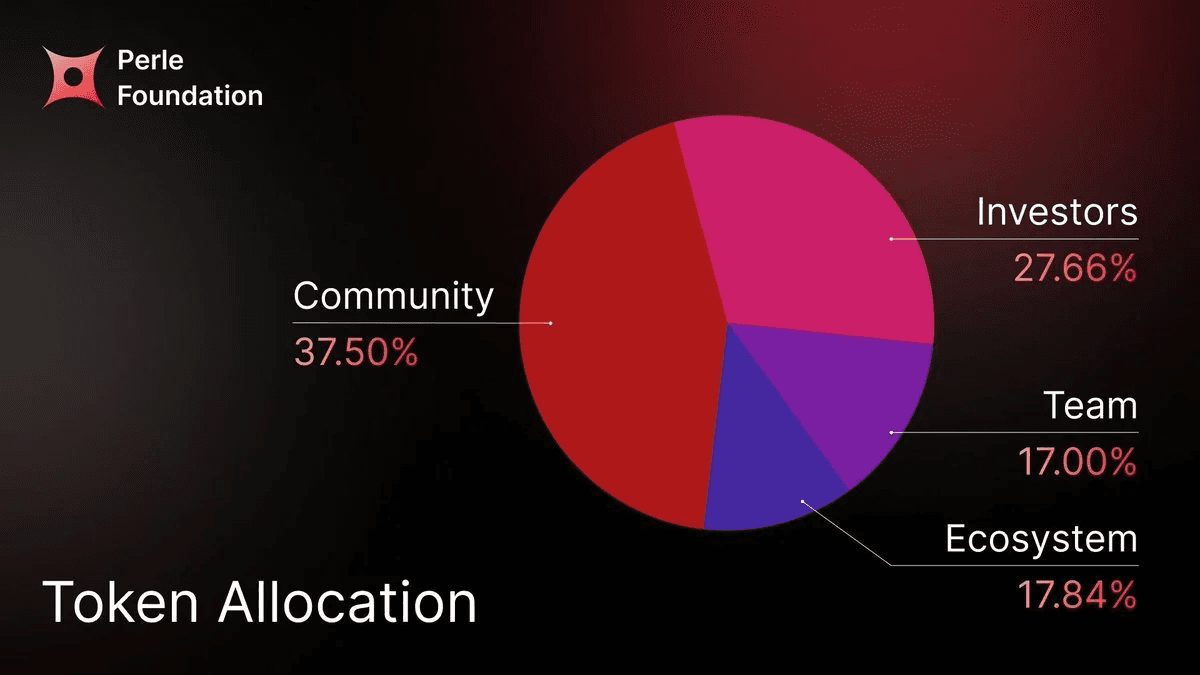
Token Details
- Token Ticker: PRL
- Blockchain: Solana
- Total Supply: 1,000,000,000 PRL (fixed supply)
- Supply Inflation: 0%
How to Trade Perle (PRL) Futures on WEEX Exchange: Step-by-Step Guide
For traders looking to capitalize on PRL’s momentum, Perle (PRL) futures offer leveraged exposure to this emerging AI data protocol.
Step 1: Secure Your Account
Before funding, apply basic security. Use a strong password and enable two-factor authentication.
Step 2: Fund with USDT
USDT funding keeps execution straightforward for USDT-margined futures and makes PnL tracking simple .
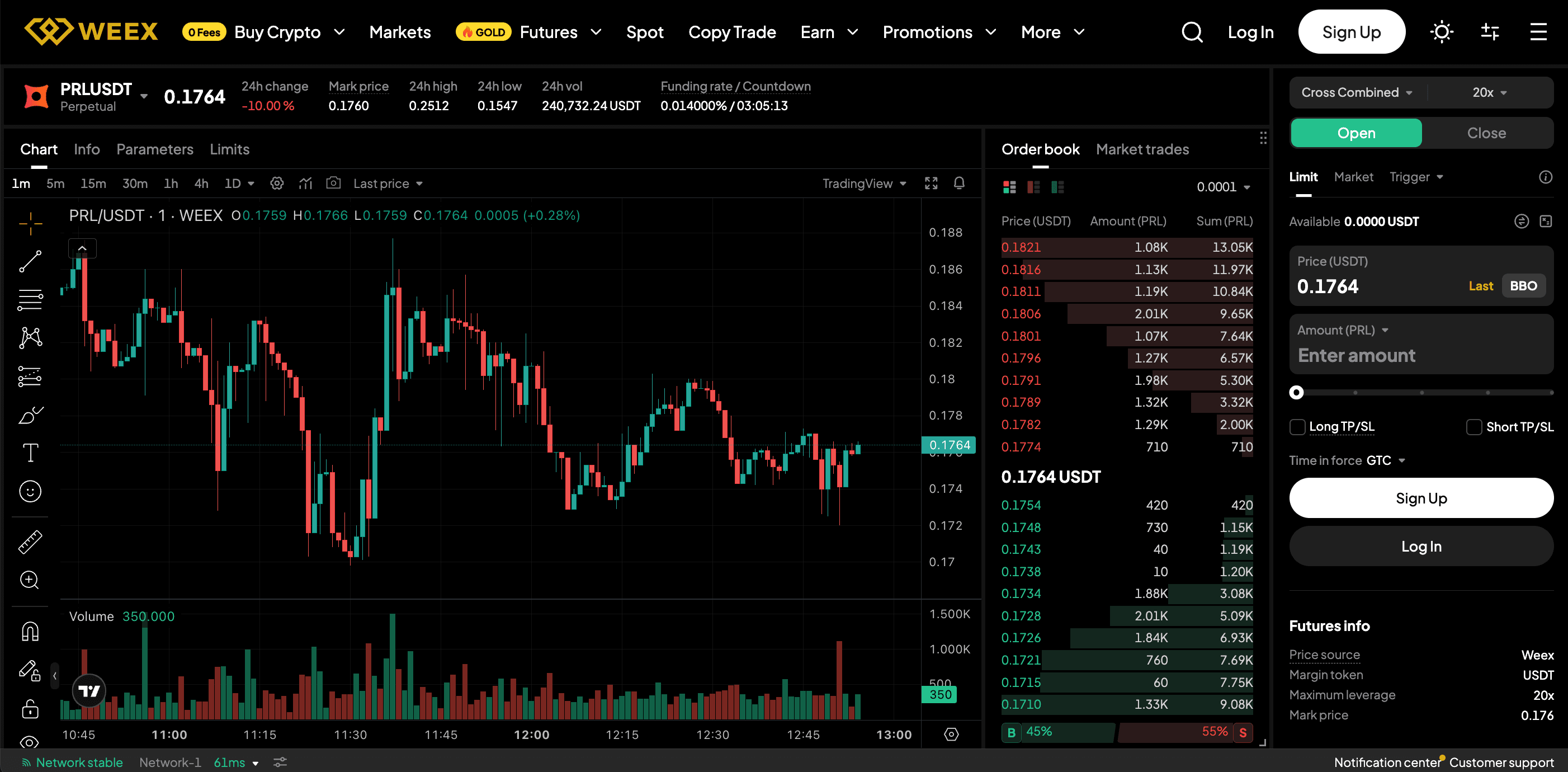
Step 3: Open the PRL/USDT Market
Search PRL/USDT and open the market page.
Step 4: Choose Margin Mode and Leverage
If isolated margin is available, it is often the cleaner choice for controlled risk per position. Select leverage intentionally. If you are unsure, start lower and increase only when your process is consistent.
Step 5: Choose an Order Type That Matches Your Plan
Pick the order type that supports discipline :
- Limit order: Controlled entry and pricing discipline
- Market order: Fast entry, but higher slippage risk in thin conditions
- Stop or trigger order: Useful for breakout entries or protective exits
For many traders, limit orders are the cleaner default because they reduce rushed execution.
Step 6: Add Risk Controls Before You Confirm
Your risk tools should be ready before the trade goes live :
- Stop-loss based on invalidation
- Take-profit level if your setup has a defined target
- Reduce-only for exit orders where available, so you do not accidentally increase exposure
Final Thoughts
As of late March 2026, Perle (PRL) has evolved from a high-growth data protocol into a foundational execution layer for the AI economy. By combining an institutional-grade matching engine with a decentralized expert network, $PRL delivers protocol-native utility backed by real revenue and high-velocity data volume.
For strategic participants, the PRL launch is a key case study in the Sovereign Intelligence thesis—infrastructure built to defend against model collapse and synthetic data loops. The platform’s 99.9% accuracy rate and $600,000 in annual cost savings for enterprise clients will define its long-term sustainability.
Success requires balance: leveraging Perle’s tools for data verification while staying mindful of the March 2027 investor unlocks and the stability of its on-chain reputation system.
Ready to trade? WEEX offers zero fees, instant execution, and the security you need. Sign up on WEEX Now and Start Trading!
FAQ
Q1: What is Perle (PRL) crypto?
Perle (PRL) is a sovereign intelligence layer on Solana that provides expert-validated, on-chain auditable data infrastructure for AI models. It prevents model collapse by ensuring AI trains on human-verified data rather than synthetic content.
Q2: What is the PRL token used for?
The $PRL token rewards expert contributors, grants priority platform access, builds on-chain reputation scores, and enables governance over the protocol’s strategic direction.
Q3: How to buy Perle (PRL) token?
PRL is available on WEEX exchange. You can buy PRL on spot markets or trade PRL/USDT perpetual futures for leveraged exposure.
Q4: How to trade Perle (PRL) futures?
Navigate to the perpetual futures section on your exchange, search for the PRL/USDT contract, set your leverage (up to 20x), and open a long or short position based on your market outlook.
You may also like
What Is SAOS? Strategic American Oil Supply Token Explained
SAOS is a meme token on Solana with a 75,000 USD market cap and 22,000 USD locked liquidity, positioned around oil supply themes but lacking real asset backing
It thrives on pure narrative speculation, with no utility, website, or doxxed team, making it highly volatile and attention-dependent
Traders should distinguish SAOS from legitimate real-world asset projects, as its branding is speculative rather than substantive
Positive aspects include locked liquidity reducing rug pull risks, but low trading activity signals high uncertainty
How to Buy Public Asset Control (PAC) Token in 2026: Latest Solana Buying Guide
How to buy Public Asset Control (PAC) token in 2026, PAC contract address, Solana wallet setup, Jupiter swap guide, latest price, liquidity, and risks.

What Is Public Asset Control (PAC) Token and How Does It Work? Latest Solana PAC Token Guide
Public Asset Control (PAC) token explained. Learn what PAC is, how it works on Solana, current price snapshot, risks, and buying basics.

Can PAC Coin Reach $1 Soon? Analyzing Public Asset Control
PAC is a Solana-based meme token with a government-themed narrative, but it is highly speculative.
At its current price (~$0.0009) and 1B supply, reaching $1 would require a $1B market cap, which is very unlikely.
Short-term moves to $0.001 or $0.01 are more realistic, but the token is highly volatile due to low liquidity and hype-driven trading.
Overall, $1 is not a realistic target, and PAC is better suited for short-term speculation than long-term investment.

United Nations Oil Reserve (UNOS) Crypto: Solana Token, UN Links, and Risks
United Nations Oil Reserve (UNOS) Crypto explained: Solana token basics, UN links, oil-backing claims, market risks, contract checks, and buying cautions.

What Is Public Asset Control (PAC) Coin? Explained for Beginners
Public Asset Control (PAC) is a Solana-based token that uses a “government asset control” narrative involving oil and gold themes, but it has no verified ties to any real institutions or governments. It is mainly an entertainment-focused, speculative meme coin.
The project’s claims about links to entities like BlackRock or Palantir are unverified, and its own disclaimer states it is not a real financial or institutional asset. Like many new Solana tokens, PAC is highly volatile, with low liquidity and limited transparency, including no fully verified audit.
Overall, PAC is a high-risk speculative token driven by hype and storytelling rather than real utility. Beginners are advised to be cautious, verify contract details, and prioritize risk control before considering any trading.
What Is Official Saudi Oil Reserve (OSOR) Coin?
Learn what OSOR coin is, why its Saudi oil narrative matters, how to verify the contract, and what risks to check before trading.

Global Digital Oil Reserve (GDOR): What It Is, Risks, and How to Check It
Global Digital Oil Reserve (GDOR) is an oil-themed Solana token with unclear backing. Learn its risks, market data, and verification checklist.

Is OBC Crypto a Good Investment?
Is OBC crypto a good investment? We analyze the latest market data, holder concentration, liquidity risks, and short-term momentum. Read this before you invest in OBC token.

Can OSOR Reach $1? Full Price Analysis 2026
OSOR crypto price prediction 2026: Can Saudi Oil Reserve token reach 1? Read before buying.

What is International Oil Supply (IOS) Coin?
Wondering what is IOS crypto? Here’s a straight look at International Oil Supply (IOS) coin—the Solana token tied to oil reserve data. Contract address, risks, and what’s still unverified.

What Is the Unified International Token (UNIT)? Is UNIT Crypto Legit or Scam?
what is UNIT crypto? Here’s a breakdown of the Unified International Token ($UNIT), how it ties to BRICS+ data, where to buy it, and why it’s a conceptual project—not an official currency.
What Is Stablecoin Business OS (SBOS) Coin?
What is SBOS crypto? We break down Stablecoin Business OS, its USDC invoicing tools, AI finance assistant, token contract address, and real utility for online businesses.

World Collective Oil Reserve ($WCOR) Price Prediction: May 2026 Rally Analysis and Future Outlook
Is $WCOR a good investment? Read our comprehensive World Collective Oil Reserve price prediction and market analysis for 2026-2030. Learn about the energy narrative on Solana and start your trading journey with WEEX rewards.

Is $PAC Token a Good Investment in 2026? Price, Risks, and Market Analysis
A data-driven analysis of Public Asset Control (PAC) token: current price, market cap, liquidity, $1 target feasibility, and risk factors. Is it a legitimate investment or a high-risk meme coin?
NEAR Airdrop: Join WEEX to Share 50,000 USDT in Crypto Rewards
Join the NEAR airdrop on WEEX from May 7 to May 14 to share a 50,000 USDT prize pool. New users can earn rewards through deposits and spot trades with zero-fee trading advantages.

How to Buy $WCOR Coin: Should I Invest or Is It Just Hype?
Learn how to buy $WCOR coin on Solana and explore its latest 57% price surge. This expert guide analyzes whether WCOR is a solid investment or speculative hype.
What Is $PAC Token? Legitimate Crypto or Just A High-Risk Meme Coin?
Is Public Asset Control ($PAC) a real asset-backed token or just another meme coin narrative? We analyze its official website, market data, and risks.
What Is SAOS? Strategic American Oil Supply Token Explained
SAOS is a meme token on Solana with a 75,000 USD market cap and 22,000 USD locked liquidity, positioned around oil supply themes but lacking real asset backing
It thrives on pure narrative speculation, with no utility, website, or doxxed team, making it highly volatile and attention-dependent
Traders should distinguish SAOS from legitimate real-world asset projects, as its branding is speculative rather than substantive
Positive aspects include locked liquidity reducing rug pull risks, but low trading activity signals high uncertainty
How to Buy Public Asset Control (PAC) Token in 2026: Latest Solana Buying Guide
How to buy Public Asset Control (PAC) token in 2026, PAC contract address, Solana wallet setup, Jupiter swap guide, latest price, liquidity, and risks.
What Is Public Asset Control (PAC) Token and How Does It Work? Latest Solana PAC Token Guide
Public Asset Control (PAC) token explained. Learn what PAC is, how it works on Solana, current price snapshot, risks, and buying basics.
Can PAC Coin Reach $1 Soon? Analyzing Public Asset Control
PAC is a Solana-based meme token with a government-themed narrative, but it is highly speculative.
At its current price (~$0.0009) and 1B supply, reaching $1 would require a $1B market cap, which is very unlikely.
Short-term moves to $0.001 or $0.01 are more realistic, but the token is highly volatile due to low liquidity and hype-driven trading.
Overall, $1 is not a realistic target, and PAC is better suited for short-term speculation than long-term investment.
United Nations Oil Reserve (UNOS) Crypto: Solana Token, UN Links, and Risks
United Nations Oil Reserve (UNOS) Crypto explained: Solana token basics, UN links, oil-backing claims, market risks, contract checks, and buying cautions.
What Is Public Asset Control (PAC) Coin? Explained for Beginners
Public Asset Control (PAC) is a Solana-based token that uses a “government asset control” narrative involving oil and gold themes, but it has no verified ties to any real institutions or governments. It is mainly an entertainment-focused, speculative meme coin.
The project’s claims about links to entities like BlackRock or Palantir are unverified, and its own disclaimer states it is not a real financial or institutional asset. Like many new Solana tokens, PAC is highly volatile, with low liquidity and limited transparency, including no fully verified audit.
Overall, PAC is a high-risk speculative token driven by hype and storytelling rather than real utility. Beginners are advised to be cautious, verify contract details, and prioritize risk control before considering any trading.


