
What Is American Fortress (AF)? Full Project Overview


As crypto adoption accelerates, so do the risks—especially phishing attacks caused by complex, error-prone wallet addresses. American Fortress (AF) enters the scene as a purpose-built solution designed to make digital transactions both simple and secure. By replacing long wallet strings with human-readable names, this project introduces a new standard for usability, privacy, and trust in blockchain transactions.
In this guide, we’ll answer what is American Fortress, explore its innovative Send-to-Name technology, explain the role of the AF token, and show you how this project fits into the broader crypto security landscape.
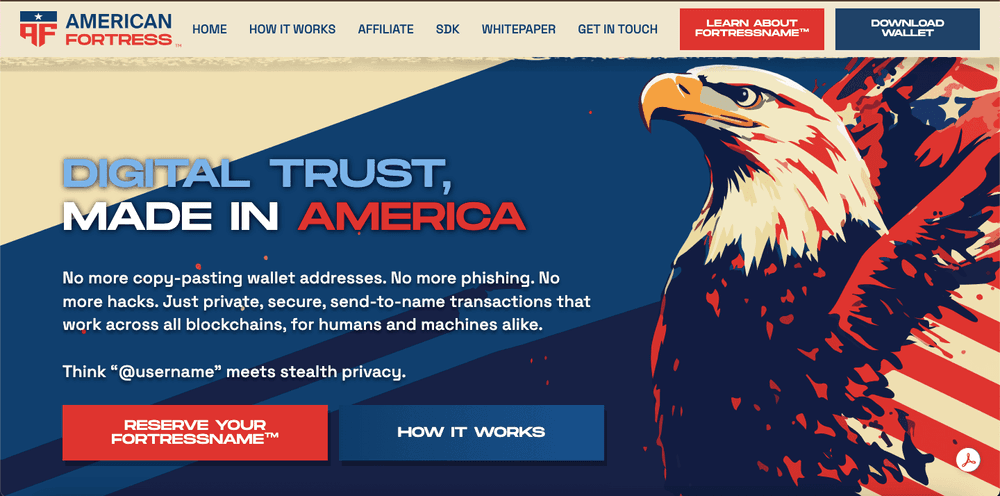
What Is American Fortress (AF)?
American Fortress (AF) is a crypto project that aims to redefine digital trust by enabling secure, human-readable transactions across blockchains. Instead of sending crypto to long, error-prone wallet addresses—often the source of costly mistakes and phishing attacks—users can send funds using a simple name format, similar to a username.
This innovation directly addresses one of crypto’s biggest pain points: the complexity of wallet addresses. By simplifying how users interact with blockchain addresses, American Fortress reduces the risk of sending funds to the wrong recipient or falling victim to address spoofing attacks.
For anyone asking what is American Fortress crypto, the answer is simple: it’s a usability layer for blockchain, making transactions as easy as sending an email while maintaining the security and decentralization that crypto promises.
How Send-to-Name Technology Works
At the core of the American Fortress ecosystem is its proprietary Send-to-Name system. Unlike traditional naming services that simply map a name to a static wallet address, American Fortress takes security a step further by automatically generating unique, one-time stealth addresses for every transaction pair.
Key Features:
- Human-Readable Transactions: Send crypto using a name (e.g., “John”) instead of a long wallet address. No more copying and pasting strings of random characters.
- Phishing Resistance: Wallet addresses are never reused or exposed publicly. Each transaction uses a fresh, one-time address, eliminating the risk of address poisoning attacks.
- Privacy-First Design: Transaction details are visible only to the sender and receiver, providing a layer of privacy that standard blockchain transactions lack.
- Cross-Chain Compatibility: Designed to work across multiple blockchains, making it a versatile solution for the multi-chain future.
This system ensures that transactions are both secure and intuitive, making crypto more accessible for everyday users and institutions alike.
The Role of the AF Token in the Ecosystem
The AF token is the backbone of the American Fortress platform. It powers the infrastructure that enables secure name-based transactions and maintains the integrity of the network.
- Secures the Decentralized Naming System: Users stake or burn AF tokens to register and secure human-readable names, preventing squatting and ensuring the system remains trustless.
- Supports Transaction Validation: The token is used to pay for the dynamic address generation service, ensuring that every transaction is validated and recorded.
- Powers Ecosystem Incentives: AF tokens reward participants who help secure the network and provide liquidity.
- Governance: Future plans include decentralized governance, allowing AF holders to vote on protocol upgrades and fee structures.
By integrating utility with security, the AF token explained becomes clear: it’s not just a speculative asset—it’s the fuel that powers a more secure and user-friendly blockchain experience.
American Fortress vs. Traditional Blockchain Naming Services
One common question is how American Fortress compares to existing solutions like Ethereum Name Service (ENS). Here’s a quick breakdown:
Feature | American Fortress (AF) | Traditional Naming Services (e.g., ENS) |
Address Reuse | One-time stealth addresses for each transaction | Static address linked to name |
Privacy | Transaction details private to sender/receiver | Transactions publicly visible on blockchain |
Phishing Risk | Eliminated (addresses never reused) | Still present if user interacts with wrong contract |
Compliance Features | Built-in decentralized KYC/AML options | Typically lacks compliance tools |
AI Integration | Native support for AI agent transactions | Requires additional development |
This comparison highlights why American Fortress crypto offers a unique value proposition, especially for users who prioritize privacy and security.
American Fortress (AF) Utilities
The AF crypto project is designed for a wide range of users, from individual holders to large institutions:
- Institutions: Secure, compliant crypto transactions with built-in decentralized KYC/AML features, making it easier for regulated entities to adopt blockchain technology.
- Developers: Easy SDK integration allows developers to add Send-to-Name functionality to their apps, wallets, and AI agents.
- Regulators: Privacy-preserving infrastructure with compliance features strikes a balance between user privacy and regulatory requirements.
- Everyday Users: Simple, safe, and user-friendly crypto transfers—no more worrying about copying the wrong address or falling for phishing scams.
- AI Agents: As AI-driven payments grow, American Fortress provides the infrastructure for autonomous agents to transact securely without human intervention.
How to Buy American Fortress (AF): Step-by-Step Guide for Beginners
If you’re interested in getting involved with the project, here’s how to buy American Fortress (AF) :
Step 1: Create a Wallet
Set up a self-custodial wallet like MetaMask, Phantom, or Trust Wallet. Store your recovery phrase securely—never share it.
Step 2: Fund Your Wallet
Buy the native blockchain token (ETH, BNB, or SOL) on an exchange like Bitrue, Binance, or Coinbase. Withdraw it to your wallet address.
Step 3: Connect to a DEX
Go to a decentralized exchange and connect your wallet.
Step 4: Swap for AF Tokens
Search for AF using the official contract address (verify via the project’s official channels). Enter the amount and confirm the swap.
Step 5: Register Your Name
Hold AF tokens to register your human-readable name on the American Fortress platform and start sending crypto securely.
Why American Fortress (AF) Crypto Stands Out
The American Fortress crypto project offers several distinct advantages compared to traditional blockchain systems and even existing naming services:
- Eliminates Wallet Confusion: No more copying and pasting long addresses or worrying about clipboard malware.
- Built for Compliance: Decentralized KYC/AML features make it suitable for institutional adoption.
- AI-Ready Payments: Enables autonomous AI agents to transact securely, positioning the project for the next wave of Web3 innovation.
- Privacy by Design: One-time stealth addresses ensure that your transaction history isn’t publicly linked to your identity.
- Cross-Chain Vision: Designed to work across multiple blockchains, avoiding vendor lock-in.
These features position American Fortress as a forward-looking solution for both Web3 users and developers who value security, privacy, and ease of use.
Conclusion
American Fortress (AF) introduces a powerful solution to one of crypto’s biggest challenges: the tension between security and usability. With its Send-to-Name technology, privacy-first design, and AI-ready infrastructure, the project aims to make blockchain transactions safer, more intuitive, and more accessible to a broader audience.
As phishing attacks and wallet-related errors continue to cause significant losses, innovations like what is American Fortress represent a meaningful step toward a more secure digital finance ecosystem. Whether you’re an individual user, a developer, or an institution, American Fortress offers a compelling vision for the future of crypto transactions.
Ready to trade? WEEX offers zero fees, instant execution, and the security you need. Sign up on WEEX Now and Start Trading!
FAQ
Q1: What is American Fortress (AF)?
American Fortress (AF) is a crypto project that replaces complex wallet addresses with human-readable names using Send-to-Name technology. It enhances security, privacy, and usability for blockchain transactions.
Q2: How does Send-to-Name technology work?
Instead of sending crypto to a long wallet address, users send to a simple name (like a username). The system automatically generates a unique, one-time stealth address for each transaction, preventing address reuse and phishing attacks.
Q3: What is the AF token used for?
The AF token powers the American Fortress ecosystem. It is used to register human-readable names, secure the naming system, pay for transaction services, and will eventually enable governance participation.
Q4: How is American Fortress different from ENS?
Unlike traditional naming services that map a name to a static address, American Fortress uses one-time stealth addresses for each transaction, providing enhanced privacy and phishing resistance. It also includes built-in compliance features and AI-ready infrastructure.
Q5: Is American Fortress a good investment?
As with any crypto project, investing in AF carries risks. Its value depends on adoption of its Send-to-Name technology, partnerships, and overall market conditions. Do your own research (DYOR) and consider your risk tolerance before investing.
You may also like
What Is SAOS? Strategic American Oil Supply Token Explained
SAOS is a meme token on Solana with a 75,000 USD market cap and 22,000 USD locked liquidity, positioned around oil supply themes but lacking real asset backing
It thrives on pure narrative speculation, with no utility, website, or doxxed team, making it highly volatile and attention-dependent
Traders should distinguish SAOS from legitimate real-world asset projects, as its branding is speculative rather than substantive
Positive aspects include locked liquidity reducing rug pull risks, but low trading activity signals high uncertainty
How to Buy Public Asset Control (PAC) Token in 2026: Latest Solana Buying Guide
How to buy Public Asset Control (PAC) token in 2026, PAC contract address, Solana wallet setup, Jupiter swap guide, latest price, liquidity, and risks.

What Is Public Asset Control (PAC) Token and How Does It Work? Latest Solana PAC Token Guide
Public Asset Control (PAC) token explained. Learn what PAC is, how it works on Solana, current price snapshot, risks, and buying basics.
Can PAC Coin Reach $1 Soon? Analyzing Public Asset Control
PAC is a Solana-based meme token with a government-themed narrative, but it is highly speculative.
At its current price (~$0.0009) and 1B supply, reaching $1 would require a $1B market cap, which is very unlikely.
Short-term moves to $0.001 or $0.01 are more realistic, but the token is highly volatile due to low liquidity and hype-driven trading.
Overall, $1 is not a realistic target, and PAC is better suited for short-term speculation than long-term investment.

United Nations Oil Reserve (UNOS) Crypto: Solana Token, UN Links, and Risks
United Nations Oil Reserve (UNOS) Crypto explained: Solana token basics, UN links, oil-backing claims, market risks, contract checks, and buying cautions.

What Is Public Asset Control (PAC) Coin? Explained for Beginners
Public Asset Control (PAC) is a Solana-based token that uses a “government asset control” narrative involving oil and gold themes, but it has no verified ties to any real institutions or governments. It is mainly an entertainment-focused, speculative meme coin.
The project’s claims about links to entities like BlackRock or Palantir are unverified, and its own disclaimer states it is not a real financial or institutional asset. Like many new Solana tokens, PAC is highly volatile, with low liquidity and limited transparency, including no fully verified audit.
Overall, PAC is a high-risk speculative token driven by hype and storytelling rather than real utility. Beginners are advised to be cautious, verify contract details, and prioritize risk control before considering any trading.
What Is Official Saudi Oil Reserve (OSOR) Coin?
Learn what OSOR coin is, why its Saudi oil narrative matters, how to verify the contract, and what risks to check before trading.

Global Digital Oil Reserve (GDOR): What It Is, Risks, and How to Check It
Global Digital Oil Reserve (GDOR) is an oil-themed Solana token with unclear backing. Learn its risks, market data, and verification checklist.
Is OBC Crypto a Good Investment?
Is OBC crypto a good investment? We analyze the latest market data, holder concentration, liquidity risks, and short-term momentum. Read this before you invest in OBC token.

Can OSOR Reach $1? Full Price Analysis 2026
OSOR crypto price prediction 2026: Can Saudi Oil Reserve token reach 1? Read before buying.

What is International Oil Supply (IOS) Coin?
Wondering what is IOS crypto? Here’s a straight look at International Oil Supply (IOS) coin—the Solana token tied to oil reserve data. Contract address, risks, and what’s still unverified.

What Is the Unified International Token (UNIT)? Is UNIT Crypto Legit or Scam?
what is UNIT crypto? Here’s a breakdown of the Unified International Token ($UNIT), how it ties to BRICS+ data, where to buy it, and why it’s a conceptual project—not an official currency.
What Is Stablecoin Business OS (SBOS) Coin?
What is SBOS crypto? We break down Stablecoin Business OS, its USDC invoicing tools, AI finance assistant, token contract address, and real utility for online businesses.
World Collective Oil Reserve ($WCOR) Price Prediction: May 2026 Rally Analysis and Future Outlook
Is $WCOR a good investment? Read our comprehensive World Collective Oil Reserve price prediction and market analysis for 2026-2030. Learn about the energy narrative on Solana and start your trading journey with WEEX rewards.

Is $PAC Token a Good Investment in 2026? Price, Risks, and Market Analysis
A data-driven analysis of Public Asset Control (PAC) token: current price, market cap, liquidity, $1 target feasibility, and risk factors. Is it a legitimate investment or a high-risk meme coin?
NEAR Airdrop: Join WEEX to Share 50,000 USDT in Crypto Rewards
Join the NEAR airdrop on WEEX from May 7 to May 14 to share a 50,000 USDT prize pool. New users can earn rewards through deposits and spot trades with zero-fee trading advantages.

How to Buy $WCOR Coin: Should I Invest or Is It Just Hype?
Learn how to buy $WCOR coin on Solana and explore its latest 57% price surge. This expert guide analyzes whether WCOR is a solid investment or speculative hype.
What Is $PAC Token? Legitimate Crypto or Just A High-Risk Meme Coin?
Is Public Asset Control ($PAC) a real asset-backed token or just another meme coin narrative? We analyze its official website, market data, and risks.
What Is SAOS? Strategic American Oil Supply Token Explained
SAOS is a meme token on Solana with a 75,000 USD market cap and 22,000 USD locked liquidity, positioned around oil supply themes but lacking real asset backing
It thrives on pure narrative speculation, with no utility, website, or doxxed team, making it highly volatile and attention-dependent
Traders should distinguish SAOS from legitimate real-world asset projects, as its branding is speculative rather than substantive
Positive aspects include locked liquidity reducing rug pull risks, but low trading activity signals high uncertainty
How to Buy Public Asset Control (PAC) Token in 2026: Latest Solana Buying Guide
How to buy Public Asset Control (PAC) token in 2026, PAC contract address, Solana wallet setup, Jupiter swap guide, latest price, liquidity, and risks.
What Is Public Asset Control (PAC) Token and How Does It Work? Latest Solana PAC Token Guide
Public Asset Control (PAC) token explained. Learn what PAC is, how it works on Solana, current price snapshot, risks, and buying basics.
Can PAC Coin Reach $1 Soon? Analyzing Public Asset Control
PAC is a Solana-based meme token with a government-themed narrative, but it is highly speculative.
At its current price (~$0.0009) and 1B supply, reaching $1 would require a $1B market cap, which is very unlikely.
Short-term moves to $0.001 or $0.01 are more realistic, but the token is highly volatile due to low liquidity and hype-driven trading.
Overall, $1 is not a realistic target, and PAC is better suited for short-term speculation than long-term investment.
United Nations Oil Reserve (UNOS) Crypto: Solana Token, UN Links, and Risks
United Nations Oil Reserve (UNOS) Crypto explained: Solana token basics, UN links, oil-backing claims, market risks, contract checks, and buying cautions.
What Is Public Asset Control (PAC) Coin? Explained for Beginners
Public Asset Control (PAC) is a Solana-based token that uses a “government asset control” narrative involving oil and gold themes, but it has no verified ties to any real institutions or governments. It is mainly an entertainment-focused, speculative meme coin.
The project’s claims about links to entities like BlackRock or Palantir are unverified, and its own disclaimer states it is not a real financial or institutional asset. Like many new Solana tokens, PAC is highly volatile, with low liquidity and limited transparency, including no fully verified audit.
Overall, PAC is a high-risk speculative token driven by hype and storytelling rather than real utility. Beginners are advised to be cautious, verify contract details, and prioritize risk control before considering any trading.


