
Amid the DeAI Craze, Is EMC the Value Oasis in This Bull Market?


Source: EMC Community Enthusiast
What kind of AI project can make waves in the crypto world? The answers can be diverse. But first, let's set aside more fantasies, fiction, and narratives, and look for answers from the world's top-tier and most valuable AI companies.
NVIDIA, one of the world's only three companies with a market cap exceeding three trillion dollars, is not only the cornerstone of global AI applications but also the undisputed overlord of GPU power. So, how does NVIDIA make money? The answer may not be complicated— the core of AI projects lies in computing power, especially in the battle for GPU power. The current logic of the AI industry is nothing more than a different form of the "selling shovels" business.
Recently, NVIDIA released its financial report for the third quarter of 2024, with data still impressive: $350.8 billion in revenue, a 94% year-on-year increase, surpassing analysts' expectations of $332.5 billion and exceeding the company's own performance guidance ($318.5 billion to $331.5 billion). Net profit reached $19.309 billion, compared to the second quarter's "300 billion in revenue, $165.9 billion in net profit," setting a new record high. These data not only exceeded market expectations but also once again affirmed NVIDIA's irreplaceability in the field of AI power.
Not only in the traditional financial sector, but back in the crypto world, the AI MEME craze is also sweeping through. From the initial AI MEME to the current AI Agents, an increasing number of large-scale AI-based applications are emerging, attracting a lot of capital and developer attention.
CZ, who was recently released from prison, is also very focused on AI. His recent tweets also mentioned the potential of combining AI and blockchain: "AI tagging (or AI data processing) is very suitable to be completed on-chain. It can leverage global low-cost labor, eliminate geographical bias, and enable instant payments through cryptocurrency." At the same time, Musk also announced that xAI will establish an AI game studio with the goal of "making games great again."
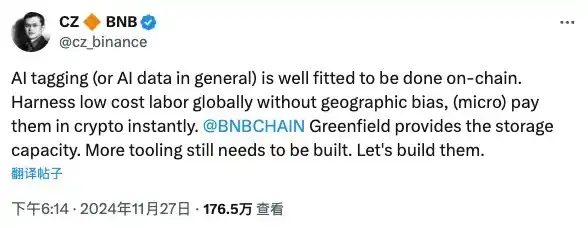
For a market like the crypto world full of "benefit mythology," replicating a 1:1 NVIDIA may be a bit too idealistic, after all, this is a behemoth with a high level of technological accumulation and market position. But if we replicate the "routine" of NVIDIA's profitability— that is, expanding the market through the core competitive advantage of powerful computing power and GPUs, perhaps it is not that difficult. Because, behind all AI Agents projects, there are massive AI models supporting them, and behind these models is the support of GPU power. Therefore, computing power remains the core driving force for the success of AI projects in the crypto world.
Crypto AI Computing Power Oasis
In this context, a project with GPU innovation that basically covers all the AI applications and possibilities you can think of in the current market: Layer 1, computing power leasing, decentralized AI+Web3 creation platform, and an AI agent project—Edge Matrix Chain, can be considered a very good ambush target, even a value oasis.
Lifting the "Heart" of AI
Traditional Layer 1 blockchains have demonstrated powerful capabilities in many areas in the past, but when you shift your focus to AI applications that require massive computational power, you will find that their computational limits cannot support these huge demands at all. AI, especially behemoths like Large Language Models (LLMs), require not just ordinary computing power but the unmatched computing power of GPUs. In the future of AI, without GPUs, nothing else matters.
EMC recognized this and thus developed a distributed GPU computing network aimed at providing sufficient computing power support for AI applications. Each EMC node not only provides ordinary computing power but offers powerful GPU support, allowing developers to run complex AI models seamlessly in a decentralized environment. What's even more astonishing is that all this computation can be done at a cost lower than traditional cluster computing. Yes, handling massive tasks is no longer the exclusive domain of cloud computing giants and no longer requires exorbitant fees.
Furthermore, EMC's network architecture further disrupts the limitations of traditional blockchains. It not only has the advantage of low latency and high throughput to ensure ultra-fast data storage and efficient retrieval, but more importantly, it provides an ideal stage for AI applications that require frequent data exchanges. In addition, EMC adopts a modular design, allowing developers to flexibly build protocol layers, network layers, application layers, and asset layers according to their needs. This design not only allows developers to focus on innovation without worrying about the limitations of the underlying architecture but also lays the foundation for the widespread application of decentralized AI.
When it comes to innovation, EMC goes beyond the technical level and brings a revolutionary product—the EMC Hub. This decentralized AI computing power scheduling platform provides unprecedented support for AI developers. Through EMC Hub, developers can build commercial AI services similar to Midjourney in just a few hours, at a cost that is only 30% of the traditional development approach.
Moreover, EMC has closely collaborated with JarvisBot to further advance decentralized AI capabilities in the market. JarvisBot, as an AI agent strongly supported by the EMC network, has successfully integrated into the TON ecosystem, offering users a diverse range of AI services: from article writing and image generation to content summarization and video creation. This AI agent was launched in June this year, putting it ahead of the market trend by almost half a year.
He Who Owns the GPU Owns the World, Possessing the Absolute Hard Currency
NVIDIA's GPU is almost the lifeblood of the entire industry, especially the NVIDIA H100 GPU, currently the latest GPU on the market.
Due to its critical importance, GPUs have also become an extremely scarce resource. Especially as AI has entered the "era of large models," the demand for GPUs has skyrocketed, making the market's supply-demand relationship increasingly tense. Obtaining high-performance GPU resources, especially top-tier chips like the NVIDIA H100, has become a form of "hard currency." For many AI companies, especially those in the early stages of startups, acquiring sufficient GPU resources is extremely challenging.
This also explains why large investment firms, such as a16z, are willing to stockpile large quantities of H100 GPUs at a high cost, renting out GPU resources to portfolio companies in exchange for equity or other benefits. It can be said that he who owns the GPU owns the world. However, as market demand is so urgent and supply is extremely limited, the "scarcity" of NVIDIA H100 GPUs has also provided investment opportunities for many industry pioneers.
Against this backdrop, EMC (Edge Matrix Chain) has utilized its innovative Layer 1 network to bridge GPU computing power with the DeFi platform, introducing a groundbreaking GPU tokenization solution. This solution not only addresses the liquidity issue of GPU computing power but also transforms these "high-performance hardware" into tradable assets, enabling more users to participate in this AI computing power ecosystem.
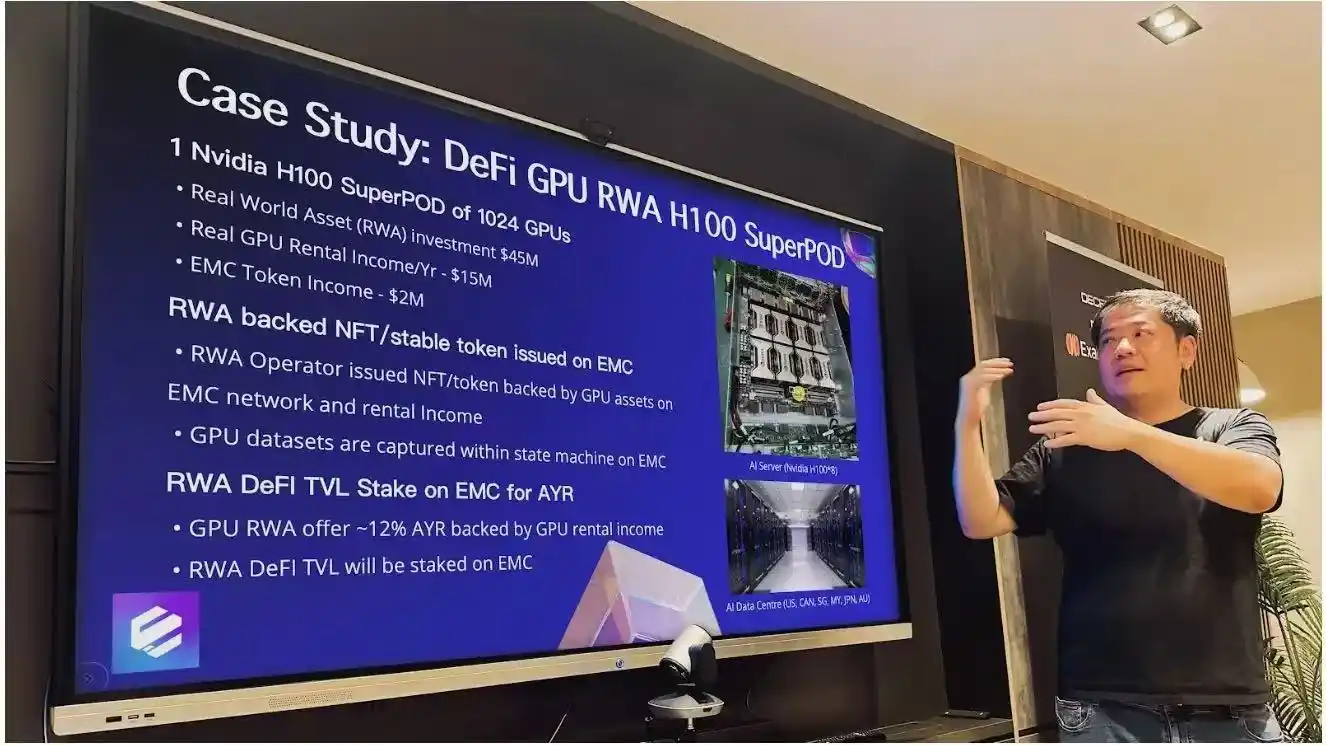
At the Token2049 conference on September 19, 2024, EMC showcased an incredibly innovative NVIDIA H100 SuperPOD Live Demo.
This modified machine, the NVIDIA H100 SuperPOD, consists of 1024 H100 GPUs, boasting powerful computing capabilities to provide substantial computing support for decentralized platforms. This computing power can not only sustain complex AI model training but also earn an annual income of up to $15 million through a GPU resource leasing model.
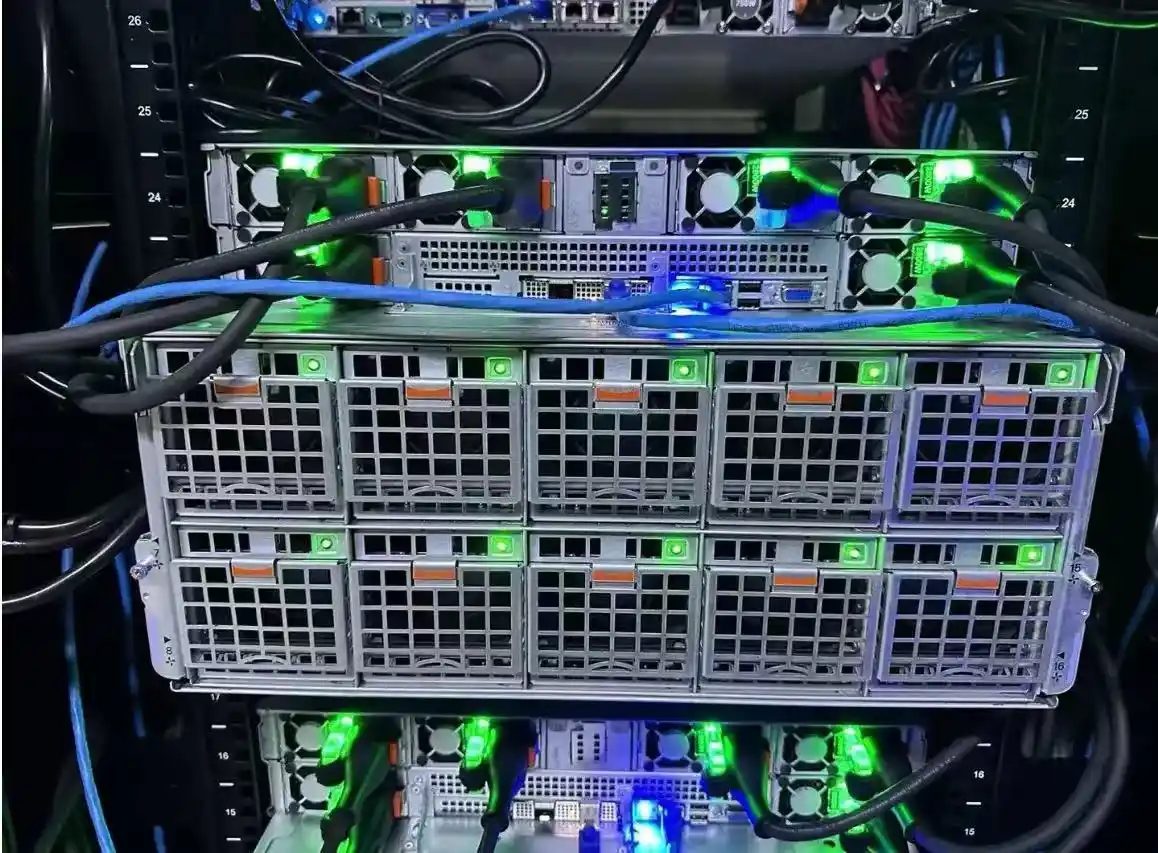
Through this demonstration, EMC not only showcased the decentralization of AI computing resources but also revealed how, through tokenizing GPU power, it is creating new economic opportunities and revenue streams for global users. What is this concept? This is not just the ultimate presentation of AI technology but also a deep exploration of the commercialization of AI computing power.
But that's not the most exciting part yet. By integrating these GPU computing resources into a decentralized platform, EMC has proposed the idea of tokenizing this high-performance hardware. In other words, global investors and developers can, through blockchain technology, break down these computing resources into small units, turning GPU power into a tradable asset. Consequently, anyone can purchase and stake this GPU power on the EMC platform, receiving approximately a 12% Annual Yield Rate (AYR) and directly participating in the AI computing wave.
Currently, the RWA assets offered by the EMC platform mainly come from top-tier high-performance GPUs such as NVIDIA A100, H100, and other models like 4090 and 3090. These GPU computing assets are provided by multiple ComputeDAO members, including significant participants like NWG and exaBITS.
This innovation not only further decentralizes AI infrastructure but also, through tokenization, breaks the traditional "high barrier to entry" of GPU resources that originally belonged to a few large enterprises, giving every ordinary user the opportunity to participate. Through EMC's technology, AI computing power has become a liquid asset rather than expensive hardware accumulated in the hands of certain institutions.
Why Is EMC Undervalued?
After introducing what EMC is doing and its unique selling points, let's return to the most crucial question: why do I think EMC is undervalued?
Let's start with the data. EMC currently spans multiple innovative fields: Layer 1 blockchain, computing power leasing, a decentralized AI+Web3 creation platform, and AI agent tools. Just looking at these concepts and business modules, its annual revenue has already reached $15 million. Considering all these highlights together, what do you think would be a reasonable market value for EMC?
If you're still having trouble giving an exact answer, let's look at the funding and valuation provided by VCs: On August 30th this year, the multi-chain infrastructure Edge Matrix Chain completed a $20 million financing round, led by P2 ventures and Amber Group.
This means that, from the perspective of these venture capital firms, EMC's valuation is approximately around 200 million US dollars. (Generally, in venture capital, when giving a valuation, a premium of about 10 times is added, and those familiar with investment know how deep the rabbit hole goes hh)
I believe this valuation is reasonable, especially considering that the current market cap of the GPU cloud mining project Ionet, which focuses solely on GPU hash power rental, is currently 300 million US dollars. And what about EMC? Not only does it have GPU hash power leasing, but it also has a whole Layer 1 blockchain network, in addition to a decentralized AI content creation platform and AI agent tools, which are four killer narrative enhancers.
Now, let's take a look at the strength behind EMC. Recently, EMC collaborated with DoraHacks to hold a high-profile hackathon, offering a direct grant of 10 million US dollars and a 1 million US dollar prize pool to support innovative projects.
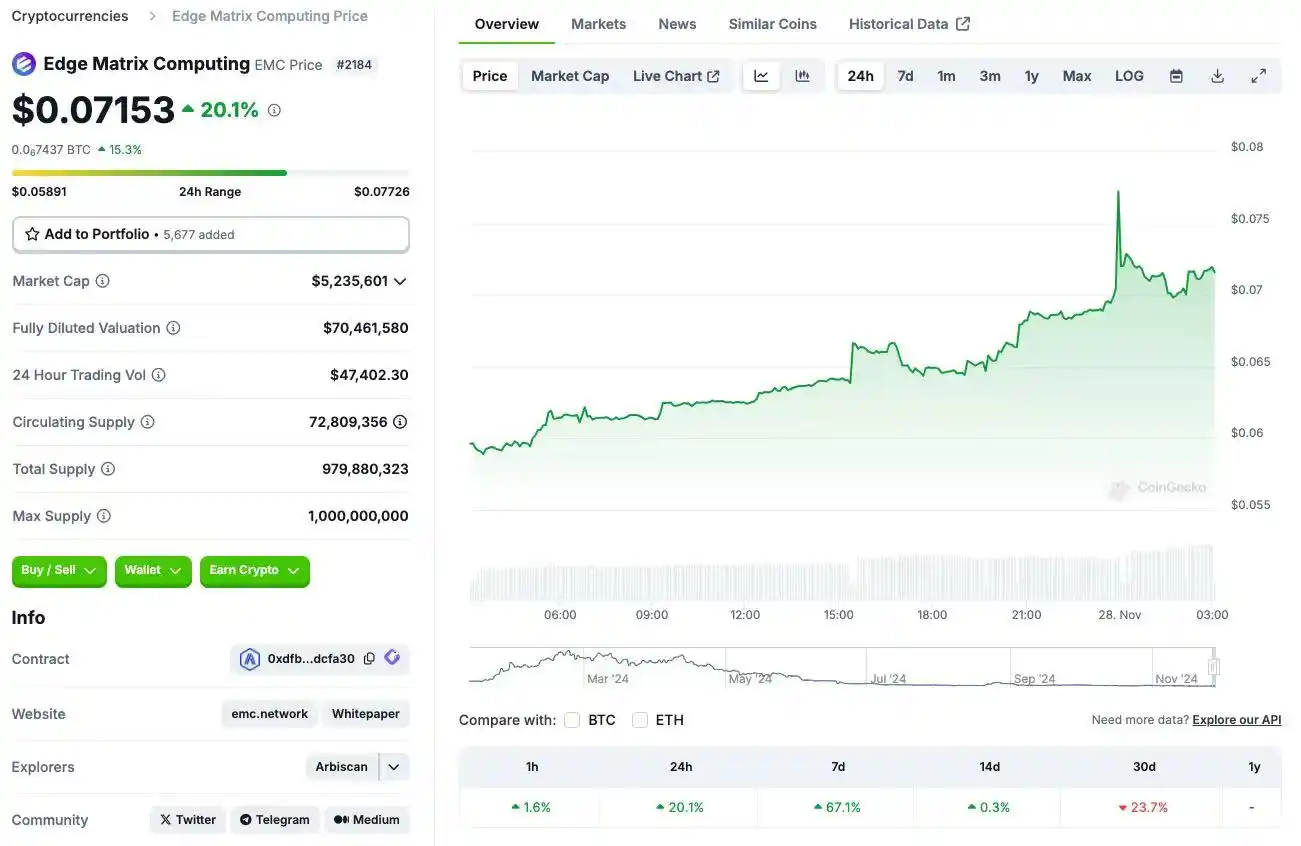
With such a project, setting aside 300 million US dollars for a moment, even if we talk about just 100 million US dollars, I don't think it's unreasonable at all, especially when nowadays there are countless meme coins launching with a quick 100 million US dollars from Pumpfun. In comparison, EMC's comprehensive advantages in technology, team, market outlook, and more can easily support a higher valuation. Currently, Edge Matrix Chain has a market cap of 5 million US dollars, surely harboring hidden alpha.
What's more interesting is that as I delved into researching the EMC project, I unexpectedly discovered that EMC had appeared in an article about GPUs in The Wall Street Journal. This article had sparked widespread attention at the time, and I had read it myself, though I didn't particularly focus on the mention of EMC back then. The title was "China's AI Engineers Are Secretly Accessing Banned Nvidia Chips".
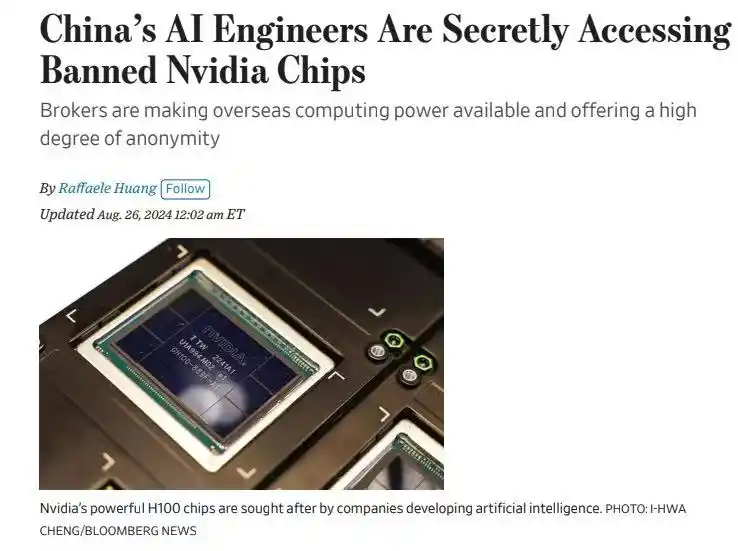
To address the shortage of hash power, Chinese AI engineers, through partnerships with international hash power suppliers, used decentralized GPU networks to access the necessary resources, and the lawyers stated that buyers, sellers, and brokers participating in accessing banned Nvidia AI chips in this manner did not violate any laws.
EMC was a key platform in this, allowing developers to access the world's top H100 GPU resources at a lower cost and with greater flexibility, widely used for training large language models (LLMs). This is undoubtedly a huge advantage for developers looking to participate in advanced AI projects.
Meanwhile, The Wall Street Journal also mentioned some technical details, such as how EMC uses smart contracts to protect transaction anonymity and ensure fair distribution of computing power. These details not only demonstrate the depth of EMC's technology but also reflect its forward-thinking approach to data privacy and security. Especially in a world where the demand for data security and privacy is increasingly growing, EMC's decentralized model appears to align more with future trends.
Moreover, The Wall Street Journal also highlighted some technical details, like how EMC safeguards transaction anonymity through smart contracts and ensures fair allocation of computing power. These details not only showcase the technical depth of EMC but also illustrate its forward-looking considerations regarding data privacy and security. Particularly in the context of a global rise in demand for data security and privacy protection, EMC's decentralized model seems even more in line with future development trends.
Nowadays, well-known AI projects have become too large in market capitalization. Once everyone realizes the potential of these projects, can they still be considered alpha?
What truly deserves exploration are often projects with lower market capitalization. Currently, EMC is undoubtedly such a hidden alpha and value oasis. If the project team collaborates on some marketing activities, waits for the right opportunity, EMC should be able to perform well.
This article is contributed content and does not represent the views of BlockBeats.
You may also like

OpenAI Reveals It Has Confidentially Submitted an S-1 to the SEC, Keeping the Door Open for a Future IPO
On June 9, according to an OpenAI announcement, the company recently confidentially submitted a draft S-1 registration statement to the U.S. Securities and Exchange Commission (SEC), beginning the preliminary compliance process for a potential initial public offering. OpenAI said it chose to disclose this proactively because it expected the news might leak; however, the company has not yet set a specific listing timeline, and related arrangements may still take some time.

Latest research from 13 top universities including Cornell University: The current state, challenges, and misconceptions of the fusion of Crypto and AI
Deconstructing Anthropic: The Best AI Company, Possibly Also a Type of Organizational Invention
Apollo and Blackstone Reportedly Back $35 Billion Anthropic Chip Financing as Deal Details Remain Unclear
On June 9, according to currently available news alerts, Apollo and Blackstone Group participated in a $35 billion financing for an Anthropic “chip project.” Based on the original wording of the report, the funding has already been raised, but public information remains limited. The financing structure, use of proceeds, project entity, and whether Apollo and Blackstone participated through equity, debt, or project financing have not yet been disclosed.

Humanity Protocol Security Incident Escalates: More Than $31 Million Stolen From Related Addresses as Attacker Continues Selling H for ETH
On June 9, according to monitoring by Onchain Lens, more than $31 million has been stolen from addresses linked to Humanity Protocol, and the attack is still ongoing, with the hacker continuously swapping H tokens for ETH. Project founder Terence Kwok later confirmed the security incident on X, saying the issue involved a private key leak.

Bloomberg: As Bitcoin Weakens, Stablecoins and RWA Continue to Drive Expansion in Crypto Businesses
In June, Bloomberg reported that despite Bitcoin falling below $60,000 last week, wiping out about $235 billion in market value within seven days, and dropping close to 50% from last year’s peak, some core businesses in the crypto industry are still expanding, mainly in stablecoins, real-world asset tokenization (RWA), payments, and infrastructure. The report also noted that overall altcoin activity has contracted significantly: altcoin market capitalization has fallen from a peak of about $431 billion in November 2021 to around $170 billion, and among the tens of millions of tokens issued in recent years, fewer than 1,700 still maintain meaningful trading activity.

Galaxy Deep Research Report: How Hyperliquid's HIP-4 Upgrade Changes the Landscape of Prediction Markets?
Binance Research: RWA Market Expected to Expand Nearly 6x from Early 2025, with Public Equities and Onchain Payments Heating Up Together
In June, Binance Research said in its monthly market report that the real-world asset (RWA) market is expected to grow by about 589% from the beginning of 2025. Bond- and money market fund-related RWA expanded by about $6.5 billion, up 83% year over year, while publicly traded equity RWAs grew by about 422%. The report also noted that monthly crypto debit card transaction volume exceeded $747 million in May, up 48.6% year to date.

Japan to Assess a Framework for Yen Stablecoins and Crypto ETFs as Asia’s Compliant Payments Narrative Heats Up
Recently, according to the original report, Japan is considering the launch of yen stablecoins and cryptocurrency ETFs. Public information remains limited at this stage, and there is still no complete policy text, regulatory draft, or clear implementation timeline, so this is better characterized as a “policy discussion” rather than formal implementation. The original wording also noted that advancing stablecoin regulation in Asia is driving XRP usage and supporting growth in the XRPL ecosystem. However, based on currently available public information, there is not enough evidence to directly establish a clear causal relationship between this round of discussion in Japan and XRP or XRPL.

ZachXBT: Humanity private key leak and abnormal surge in H token should be viewed separately
On June 9, according to related disclosures, on-chain investigator ZachXBT posted an update on Humanity’s roughly $31 million security incident, saying that after further analyzing fund flows, he currently tends to believe the project team was not involved in an “inside job” or a self-staged attack. According to him, the official explanation about the private key leak was broadly accurate, but before the token unlock, the price of H had been artificially pushed higher, and the hacker later took advantage of that market environment; therefore, the private key leak and the earlier abnormal price pumping should be regarded as two separate and independent events. This reframing has shifted the market’s understanding of the nature of the incident. Earlier discussion around Humanity had focused on whether the team directly participated in the attack or used the security incident to cover up internal operations. ZachXBT’s latest remarks shift the focus from “whether it was self-theft” to “whether there were pre-unlock market structure issues.” He also questioned whether the team may have.

Morning Report | OpenAI has submitted an S-1 registration statement draft to the U.S. SEC; Morpho completes $175 million financing

Morning Report | BitMine increased its holdings by 126,971 ETH last week; trader Eugene announced his exit from the crypto market

Wang Chuan: How can one not feel anxious after the neighbor Old Wang made thirty times profit by investing in storage stocks? (Seven) - A quarter-century cycle
Cryptocurrency CEXs are flocking to sell US stocks, and traditional brokerages are facing an "uninvited guest."
$75 billion in foreign capital has fled, and South Korean retail investors have absorbed it all using leverage

Japan’s Three Megabanks Plan Joint Stablecoin Issuance in Fiscal 2026
MUFG, SMBC, and Mizuho reportedly plan to jointly issue fiat-pegged stablecoins in fiscal 2026, signaling Japan’s growing push into bank-led digital payment infrastructure.

Humanity Discloses H Token Dual-Chain Attack Details, With Losses on Ethereum and BSC Exceeding $36 Million
Humanity said the H token attack across Ethereum and BSC caused more than $36 million in losses after leaked ProxyAdmin keys enabled malicious contract upgrades and token minting.
White House Discusses CLARITY Act With Law Enforcement Ahead of Senate Vote
The White House discussed the CLARITY Act with law enforcement ahead of a Senate vote, focusing on illicit finance risks and developer protections.
OpenAI Reveals It Has Confidentially Submitted an S-1 to the SEC, Keeping the Door Open for a Future IPO
On June 9, according to an OpenAI announcement, the company recently confidentially submitted a draft S-1 registration statement to the U.S. Securities and Exchange Commission (SEC), beginning the preliminary compliance process for a potential initial public offering. OpenAI said it chose to disclose this proactively because it expected the news might leak; however, the company has not yet set a specific listing timeline, and related arrangements may still take some time.
Latest research from 13 top universities including Cornell University: The current state, challenges, and misconceptions of the fusion of Crypto and AI
Deconstructing Anthropic: The Best AI Company, Possibly Also a Type of Organizational Invention
Apollo and Blackstone Reportedly Back $35 Billion Anthropic Chip Financing as Deal Details Remain Unclear
On June 9, according to currently available news alerts, Apollo and Blackstone Group participated in a $35 billion financing for an Anthropic “chip project.” Based on the original wording of the report, the funding has already been raised, but public information remains limited. The financing structure, use of proceeds, project entity, and whether Apollo and Blackstone participated through equity, debt, or project financing have not yet been disclosed.
Humanity Protocol Security Incident Escalates: More Than $31 Million Stolen From Related Addresses as Attacker Continues Selling H for ETH
On June 9, according to monitoring by Onchain Lens, more than $31 million has been stolen from addresses linked to Humanity Protocol, and the attack is still ongoing, with the hacker continuously swapping H tokens for ETH. Project founder Terence Kwok later confirmed the security incident on X, saying the issue involved a private key leak.
Bloomberg: As Bitcoin Weakens, Stablecoins and RWA Continue to Drive Expansion in Crypto Businesses
In June, Bloomberg reported that despite Bitcoin falling below $60,000 last week, wiping out about $235 billion in market value within seven days, and dropping close to 50% from last year’s peak, some core businesses in the crypto industry are still expanding, mainly in stablecoins, real-world asset tokenization (RWA), payments, and infrastructure. The report also noted that overall altcoin activity has contracted significantly: altcoin market capitalization has fallen from a peak of about $431 billion in November 2021 to around $170 billion, and among the tens of millions of tokens issued in recent years, fewer than 1,700 still maintain meaningful trading activity.


