
6 Major Global Institutions 2025 Outlook: AI Boom Continues, Key Year for Exploring Alpha


Original Author: Stoic
Original Translation: DeepTech TechFlow
Distill the core views of top global institutions for you, saving you time reading hundreds of pages of reports.
Data Source: J.P. Morgan, Blackrock, Deutsche Wealth, World Bank, Goldman Sachs, and Morgan Stanley.
1. J.P. Morgan's Core Views
· Global Economic Growth: It is expected that global economy will continue to grow by 2025, but China's economy may experience significant slowing.
· Stock Market Forecast: The S&P 500 index is expected to reach 6500 points, but global stock markets may show divergence.
Global Market Outlook
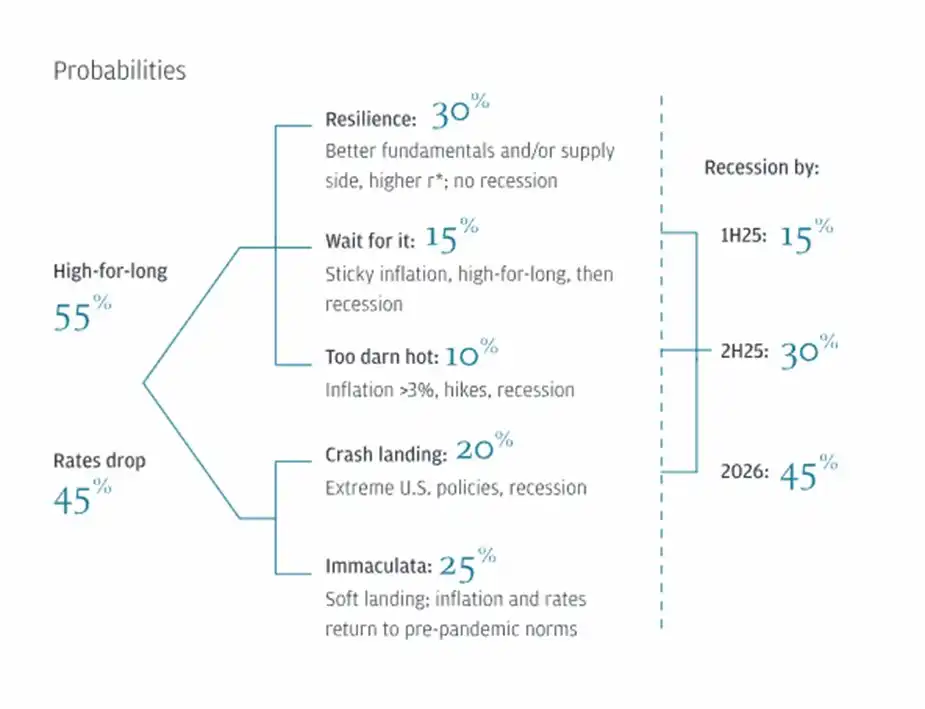
In the coming months, market trends will be influenced by the interaction of macroeconomic trends and monetary policy, while policy changes by the new U.S. administration will also bring uncertainty.
Technological innovation, especially the 'Continuation of the AI Boom,' will be a key driver of the market.
Interest Rate Outlook
The baseline forecast suggests that global economic growth is resilient, but the persistence of inflation will limit further monetary policy easing in 2025.
However, the new Trump administration may bring risks, such as overly aggressive trade and immigration policies that could impact the supply side and dent global market confidence.
Baseline Scenario Forecast
· Strong global economic growth.
· Positive outlook for U.S. stocks and gold, but the prospects for oil and base metals are not optimistic.
2. Blackrock's Core Views
· Unique Market Environment: The current market is in a unique phase, where long-term assets exhibit unusually strong reactions to short-term events.
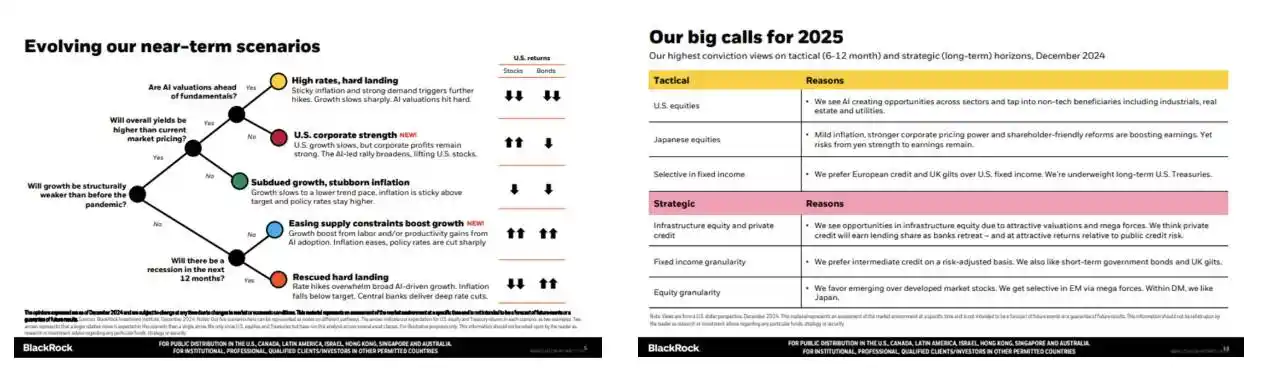
· Investment Strategy: Bullish on risk assets, further overweighting U.S. stocks as the 'AI theme is rapidly expanding'.
· Inflation and Interest Rates: It is expected that inflation and interest rates will remain at levels higher than pre-pandemic.
2025 Market Outlook
· Inflation Pressure: Due to intensified geopolitical divisions and accelerated spending on "AI infrastructure development and low-carbon transformation," inflation pressure is expected to persist.
· Fed Policy: The Fed is unlikely to significantly cut interest rates, and rates are not expected to drop below 4%.
· Long-Term Bond Yields: Given budget deficits, sticky inflation, and increased market volatility, investors may require a higher risk premium, leading to a rise in long-term government bond yields.
Key Investment Themes
· AI-Driven Investment Craze: The AI race will continue to drive market investments.
· U.S. Stocks to Continue Outperforming: U.S. stocks are expected to continue their strong performance, but investors need to be flexible in response to market changes.
· Monitoring Risk Signals: Signals such as a surge in long-term bond yields or escalated trade protectionism could be key triggers for adjusting investment strategies.
3. Deutsche Wealth's Core Views
In a backdrop of an "economically challenging environment," inflation may remain high due to "increased fiscal spending and potential tariff hikes."
"This will limit central banks' room to stimulate the economy through rate cuts, forcing them to seek a balance between growth and inflation control. This uncertainty could alter market expectations and trigger more volatility than in 2024. Additionally, geopolitical conflicts triggered by changes in trade policies could further exacerbate market instability."
Asset Allocation Themes
· The U.S. economy may achieve a soft landing, with steady economic growth and robust investment.
· Focus on growth stocks, but be cautious of high volatility risks.
· Corporate profit growth and large-scale stock buybacks will benefit the U.S. stock market.
Investment Advice:
- Focus on the long-term positive trend of economic growth.
- Consider adopting a diversified investment portfolio and actively manage risks.
Key Points Overview
· Despite geopolitical tensions and high interest rates, global economic growth is expected to edge up from 2.6% in 2024 to 2.7% in 2025-26.
· While short-term growth prospects have improved, the growth of most economies globally remains below the average level of the 2010s.
· Global inflation is expected to slowly decline, averaging 3.5% in 2025. Central banks may remain cautious in their accommodative policies.
· Risks such as geopolitical conflicts and climate disasters continue to exist, with a greater impact on vulnerable economies.
· Policy recommendations include supporting green and digital transformation, promoting debt relief, and enhancing food security.
4. World Bank Group 2025 Outlook Highlights
· Despite facing challenges from geopolitical tensions and high interest rates, global economic growth is expected to remain at 2.6% in 2024. By 2025-2026, with a gradual recovery in trade and investment, this growth rate may slightly increase to 2.7%.
· While short-term growth prospects have improved, overall performance remains weak. During 2024-2025, nearly 60% of the world's economies are projected to grow at rates lower than the average level of the 2010s, accounting for over 80% of global output and population.
· The global inflation easing is expected to be slower than previously anticipated, with an average inflation rate of 3.5% this year. Due to lingering inflationary pressures, central banks may exercise more caution in easing monetary policies.
· Recent multiple shocks have caused many emerging markets and developing economies to stagnate in catching up with advanced economies. Data shows that nearly half of EMDEs underperformed compared to advanced economies during 2020-2024. The future prospects are even bleaker for those fragile economies heavily impacted by conflicts.
· Despite a somewhat balanced risk picture, downside risks still dominate overall. Key risks include:
- Continued geopolitical tensions.
- Further global trade fragmentation.
- Sustained high interest rates coupled with persistent inflationary pressures.
-Frequent occurrence of natural disasters related to climate change.
· To address the above challenge, global policies need to focus on the following aspects:
-Maintaining the stability of the international trade system.
-Promoting green and digital transformation to support economic sustainability.
-Providing debt relief support to help alleviate the pressure on highly indebted countries.
-Improving food security issues, especially in fragile economies.
· For emerging markets and developing economies, high debt and its servicing costs pose a severe challenge. These countries need to find a balance between meeting significant investment needs and maintaining fiscal sustainability.
· To achieve long-term economic and social development goals, countries need to take the following policy measures:
-Increase productivity growth to drive economic efficiency.
-Improve the efficiency of public investments to ensure proper fund utilization.
-Enhance human capital development, such as education and skills training.
-Narrow the gender gap in the labor market and increase female labor force participation.
5. Goldman Sachs Key Insights
「2025: The Key Year for Exploring Excess Returns」
· The simultaneous occurrence of interest rate declines and economic growth may favor the stock market.
· Current stock valuations are nearing highs, and future earnings growth will be a key driver of the market.
· Since October 2023, global stock markets have risen by 40%, making the market more susceptible to negative news.
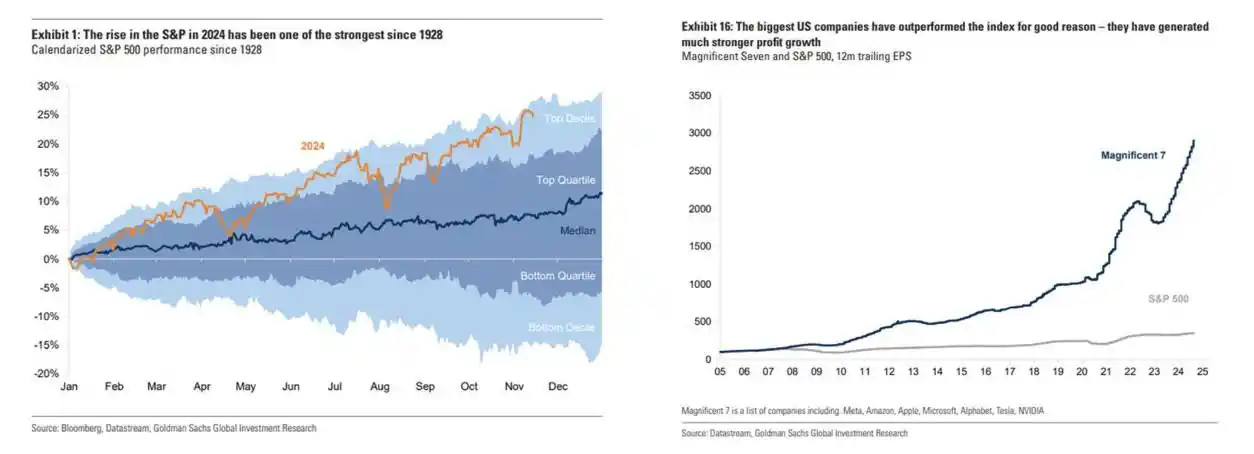
· The S&P 500 index has had one of the strongest rallies since 1928, with the Nasdaq index rising over 50%, and NVIDIA seeing a surge of up to 264%. This trend is mainly driven by expectations of "peak inflation" and a "shift in Fed policy."
· The increase in price-to-earnings ratios has brought stock and credit valuations to historic highs, especially with the performance in European and Chinese markets nearing long-term average levels, no longer in undervalued territory.
· Although stock valuations are high, this does not completely suppress the possibility of further upside. However, high valuations may exert some pressure on future returns.
· Large US tech companies have performed well, primarily benefiting from strong profit growth. Their valuation levels reflect their solid fundamentals rather than market hype.
Risk Analysis
The report mentions two key risks:
1. The recent optimism in the market has already priced in some of the future returns, making the market more vulnerable to correction.
2. There are still many unknown factors regarding tariff risks, which may introduce uncertainty.
Goldman Sachs emphasizes the strategy of "diversifying investments and achieving alpha" to address these risks.
The specific strategies include:
· Broadening the investment scope to include more asset classes;
· Seeking potential value investment opportunities;
· Achieving geographical investment diversification to mitigate risks.
6. Market Outlook from Morgan Stanley
Key Themes
1. High Market Valuations Morgan Stanley believes that current market valuations are generally high, and most investors no longer see asset prices as cheap. Therefore, it is recommended to prioritize generating alpha through optimizing asset allocation and investment selection, rather than relying solely on overall market returns (beta).
2. Bull Market Entering Optimistic Phase The market is entering the "optimistic phase" of the bull market, which is usually the late stage of a bull market, followed by a possible "euphoria phase," just before a bear market. Morgan Stanley states that "the market performance in 2025 is still expected to be promising."
3. Impact of Generative AI on the Private Market The potential impact of Generative AI on the private market is considered one of the key themes for 2025. The rapid development of this technology may bring new opportunities and challenges to private equity investments.
Summary and Recommendations
From the perspectives of major institutions, some common trends and themes can be identified, such as high market valuations, the impact of AI technology, and the importance of diversified investments. These insights can serve as references for investors when formulating strategies.
It is important to note that these perspectives are not absolute truths but rather provide different viewpoints for investors to compare and analyze.
If this content receives enough attention, I plan to write an article specifically discussing the cryptocurrency market outlook. If there are any other noteworthy reports or materials from research institutions, please feel free to recommend them to me as I am very keen to further research.
You may also like

Meet the new WEEX trial fund—your gateway to greater profits

WEEX Labs Lands at Dutch Blockchain Week: A Disruptive Crypto × AI Conversation Sets Sail in Amsterdam

SK Hynix Reportedly Plans U.S. ADR Listing as Early as August, With SEC Approval Possible in Late June
SK Hynix may pursue a U.S. ADR listing as early as August, with SEC approval reportedly possible in late June amid strong AI chip supply chain demand.

SpaceX vs Tesla vs xAI: Which Elon Musk Trade Has the Biggest Upside in 2026?
OpenAI Reveals It Has Confidentially Submitted an S-1 to the SEC, Keeping the Door Open for a Future IPO
On June 9, according to an OpenAI announcement, the company recently confidentially submitted a draft S-1 registration statement to the U.S. Securities and Exchange Commission (SEC), beginning the preliminary compliance process for a potential initial public offering. OpenAI said it chose to disclose this proactively because it expected the news might leak; however, the company has not yet set a specific listing timeline, and related arrangements may still take some time.

Latest research from 13 top universities including Cornell University: The current state, challenges, and misconceptions of the fusion of Crypto and AI
Deconstructing Anthropic: The Best AI Company, Possibly Also a Type of Organizational Invention
Apollo and Blackstone Reportedly Back $35 Billion Anthropic Chip Financing as Deal Details Remain Unclear
On June 9, according to currently available news alerts, Apollo and Blackstone Group participated in a $35 billion financing for an Anthropic “chip project.” Based on the original wording of the report, the funding has already been raised, but public information remains limited. The financing structure, use of proceeds, project entity, and whether Apollo and Blackstone participated through equity, debt, or project financing have not yet been disclosed.

Humanity Protocol Security Incident Escalates: More Than $31 Million Stolen From Related Addresses as Attacker Continues Selling H for ETH
On June 9, according to monitoring by Onchain Lens, more than $31 million has been stolen from addresses linked to Humanity Protocol, and the attack is still ongoing, with the hacker continuously swapping H tokens for ETH. Project founder Terence Kwok later confirmed the security incident on X, saying the issue involved a private key leak.

Bloomberg: As Bitcoin Weakens, Stablecoins and RWA Continue to Drive Expansion in Crypto Businesses
In June, Bloomberg reported that despite Bitcoin falling below $60,000 last week, wiping out about $235 billion in market value within seven days, and dropping close to 50% from last year’s peak, some core businesses in the crypto industry are still expanding, mainly in stablecoins, real-world asset tokenization (RWA), payments, and infrastructure. The report also noted that overall altcoin activity has contracted significantly: altcoin market capitalization has fallen from a peak of about $431 billion in November 2021 to around $170 billion, and among the tens of millions of tokens issued in recent years, fewer than 1,700 still maintain meaningful trading activity.

Galaxy Deep Research Report: How Hyperliquid's HIP-4 Upgrade Changes the Landscape of Prediction Markets?
Binance Research: RWA Market Expected to Expand Nearly 6x from Early 2025, with Public Equities and Onchain Payments Heating Up Together
In June, Binance Research said in its monthly market report that the real-world asset (RWA) market is expected to grow by about 589% from the beginning of 2025. Bond- and money market fund-related RWA expanded by about $6.5 billion, up 83% year over year, while publicly traded equity RWAs grew by about 422%. The report also noted that monthly crypto debit card transaction volume exceeded $747 million in May, up 48.6% year to date.

Japan to Assess a Framework for Yen Stablecoins and Crypto ETFs as Asia’s Compliant Payments Narrative Heats Up
Recently, according to the original report, Japan is considering the launch of yen stablecoins and cryptocurrency ETFs. Public information remains limited at this stage, and there is still no complete policy text, regulatory draft, or clear implementation timeline, so this is better characterized as a “policy discussion” rather than formal implementation. The original wording also noted that advancing stablecoin regulation in Asia is driving XRP usage and supporting growth in the XRPL ecosystem. However, based on currently available public information, there is not enough evidence to directly establish a clear causal relationship between this round of discussion in Japan and XRP or XRPL.

ZachXBT: Humanity private key leak and abnormal surge in H token should be viewed separately
On June 9, according to related disclosures, on-chain investigator ZachXBT posted an update on Humanity’s roughly $31 million security incident, saying that after further analyzing fund flows, he currently tends to believe the project team was not involved in an “inside job” or a self-staged attack. According to him, the official explanation about the private key leak was broadly accurate, but before the token unlock, the price of H had been artificially pushed higher, and the hacker later took advantage of that market environment; therefore, the private key leak and the earlier abnormal price pumping should be regarded as two separate and independent events. This reframing has shifted the market’s understanding of the nature of the incident. Earlier discussion around Humanity had focused on whether the team directly participated in the attack or used the security incident to cover up internal operations. ZachXBT’s latest remarks shift the focus from “whether it was self-theft” to “whether there were pre-unlock market structure issues.” He also questioned whether the team may have.

Morning Report | OpenAI has submitted an S-1 registration statement draft to the U.S. SEC; Morpho completes $175 million financing

Morning Report | BitMine increased its holdings by 126,971 ETH last week; trader Eugene announced his exit from the crypto market

Wang Chuan: How can one not feel anxious after the neighbor Old Wang made thirty times profit by investing in storage stocks? (Seven) - A quarter-century cycle
Cryptocurrency CEXs are flocking to sell US stocks, and traditional brokerages are facing an "uninvited guest."
Meet the new WEEX trial fund—your gateway to greater profits
WEEX Labs Lands at Dutch Blockchain Week: A Disruptive Crypto × AI Conversation Sets Sail in Amsterdam
SK Hynix Reportedly Plans U.S. ADR Listing as Early as August, With SEC Approval Possible in Late June
SK Hynix may pursue a U.S. ADR listing as early as August, with SEC approval reportedly possible in late June amid strong AI chip supply chain demand.
SpaceX vs Tesla vs xAI: Which Elon Musk Trade Has the Biggest Upside in 2026?
OpenAI Reveals It Has Confidentially Submitted an S-1 to the SEC, Keeping the Door Open for a Future IPO
On June 9, according to an OpenAI announcement, the company recently confidentially submitted a draft S-1 registration statement to the U.S. Securities and Exchange Commission (SEC), beginning the preliminary compliance process for a potential initial public offering. OpenAI said it chose to disclose this proactively because it expected the news might leak; however, the company has not yet set a specific listing timeline, and related arrangements may still take some time.
Latest research from 13 top universities including Cornell University: The current state, challenges, and misconceptions of the fusion of Crypto and AI


